

Noted B2B eCommerce guru Jason Greenwood on his THE ECOMMERCE EDGE (which, if you are in senior management, sales leadership, marketing, or eCommerce you should subscribe) recently wrote about “the silver tsunami” and the opportunity, and role, for eCommerce … and AI.
We’ve all seen the number of people retiring from the industry. We all look around at conferences and see the sea of gray hair. There are lots of comments. It is in distribution, manufacturing, reps … and yes, customers.
It’s a fact of life.
And the next generation is coming. More and more of them will want to do business differently and need to for reasons specific to their business. At the same time, distributors and manufacturers are embracing, sometimes reluctantly, that they need to change. Many have eCommerce systems but barely embrace them (and some consider it a “necessary evil.) From our viewpoint, having worked with clients in electrical, HVAC and industrial supply industries, there is probably a 3-year window of “embrace or ‘go home’. “Home may not be close, but share will decline, hiring will be more challenging, and profits will wither.
Here is what Jason is seeing:
The Silver Tsunami: How the B2B Sales Rep Retirement Wave is FORCING Digitalization
The demographic shift reshaping industrial supply chains is often referred to quietly as the “Silver Tsunami.”
Yet, it has become one of the most powerful and understated catalysts for B2B digital transformation today.
For decades, manufacturers, distributors, and wholesalers relied heavily on “relationship continuity” for business growth and client stickiness.
A single veteran sales rep managed a territory for thirty years, carrying critical client nuances, pricing logic, product substitution knowledge and much more entirely in their head. And what they did not have in their head, they knew how and where to get it from the internal ERP or from the shared network drive to package up for each customer request.
As these reps age out or move to competitors, companies are facing a massive loss of institutional and tribal knowledge.
This reality is forcing organizations to aggressively transition from a people-dependent model to a system-dependent model.
Current data and detailed forecasts highlight the sheer scale of this retirement wave and demonstrate how it is actively driving digitization across the B2B landscape.
The Scale of the “Silver Tsunami”
The timeline for this transition is incredibly compressed and the numbers are staggering.
According to data tracked by B2B sales advisory firms, 60% of veteran B2B sales reps are projected to retire within the next three years, by 2029 [1].
Many of these reps are highly tenured Baby Boomers who have hit retirement eligibility simultaneously, creating an unprecedented vacuum of senior sales talent.
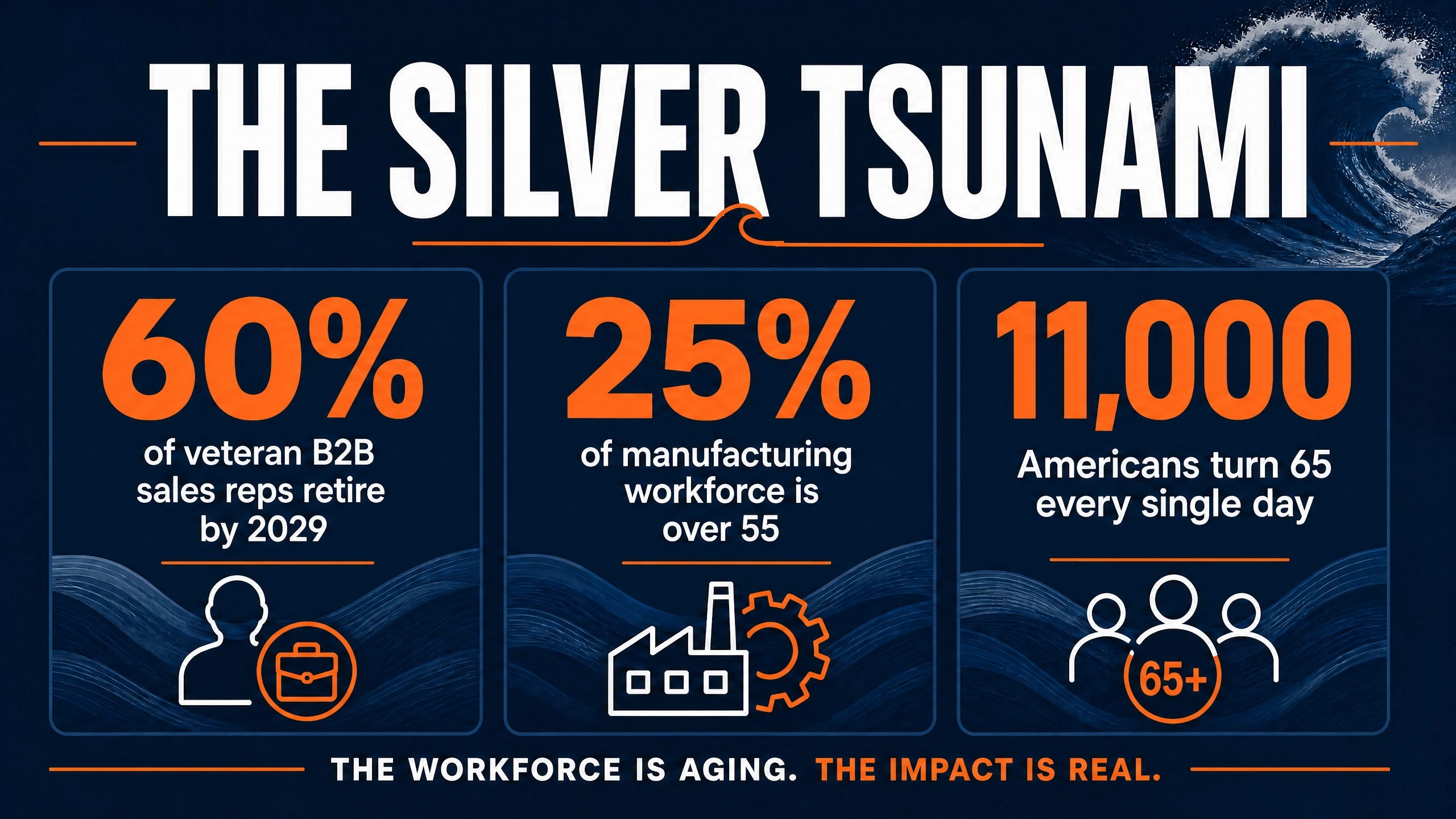
This demographic reality heavily impacts manufacturing, wholesale, and distribution supply chains.
Data from the U.S. Bureau of Labor Statistics (BLS) shows that roughly one-quarter (25%) of the entire workforce in manufacturing and wholesale trade is over the age of 55 [2].
- The broader demographic context is equally striking: analysis indicates that more than four million Americans are turning 65 each year through 2027 – averaging roughly 11,000 people per day aging into traditional retirement brackets [3]!
- The Manufacturing Institute and Deloitte project that 3.8 million manufacturing jobs will need to be filled by 2033, with 2.8 million of those being direct replacements for retiring workers [4].
- A staggering 97% of manufacturing firms report being aware of the aging workforce issue, and 97% express specific concern about brain drain and the loss of institutional knowledge [4].
The Threat of “Retired in Place”
Before they even officially exit, aging reps present a hidden digital risk known as “retired in place” or “quiet quitting.”
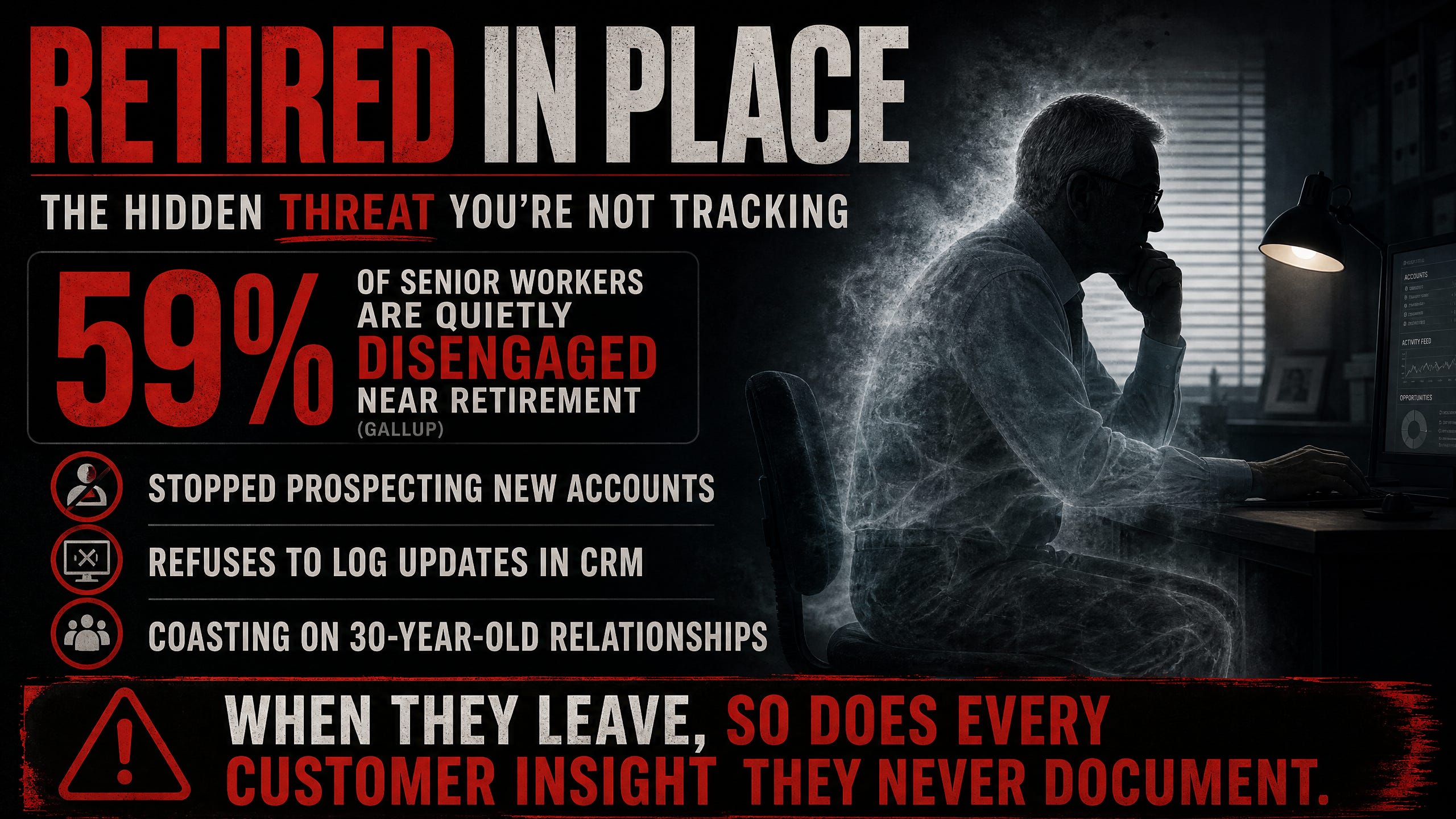
Global workforce data highlights that 59% of senior workers fit a disengaged or “quiet quitting” profile near the end of their careers [1].
In a B2B context, this often looks like:
- A veteran rep no longer prospecting
- Avoiding overnight travel
- Refusing to log account updates into the CRM
- Hindering digitalization efforts
- Refusing to learn or contribute to eCommerce and/or AI adoption in the enterprise
They coast strictly on their decades-old relationships.
When they finally log off for good, the company realizes it has absolutely no digital record of how those key accounts were actually maintained or serviced.
Why This Forces Digitalization: The “Tenure Collapse”
Historically, a distributor could replace a retiring 60-year-old rep with a 30-year-old apprentice who would shadow them and learn by osmosis over five years.
That model has completely broken down due to shifting workforce dynamics.
According to the BLS, workers aged 55 to 64 boast an average job tenure of nearly 10 years, and often 20 or more years in industrial sales.
Conversely, younger workers aged 25 to 34 average only 2.7 years at a job, and Gen Z’s average tenure in their first five years of employment drops to just 1.1 years [2].
Workplace loyalty ain’t what it used to be!
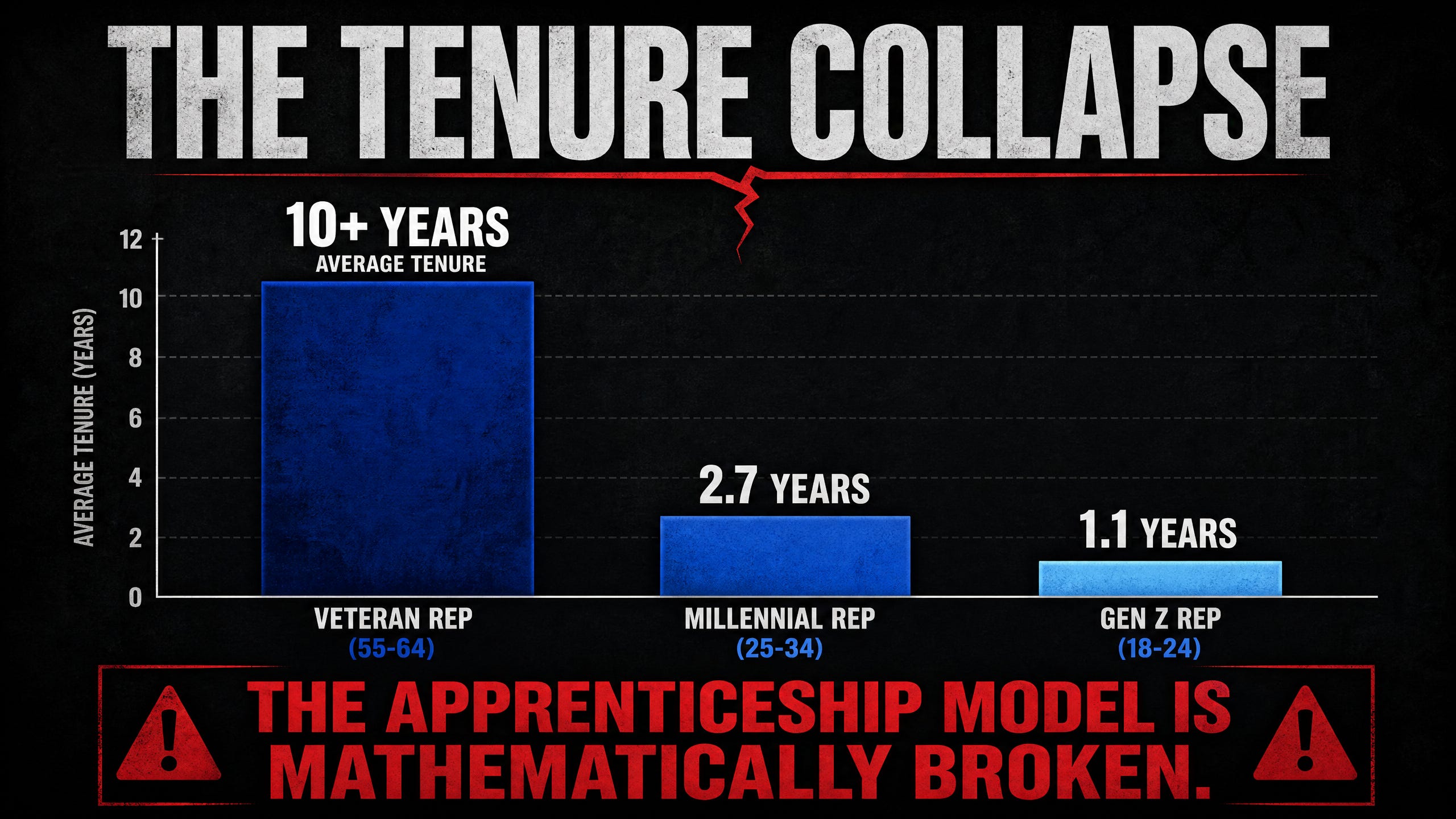
The math simply does not work anymore.
Because younger reps change jobs every one to three years, manufacturers can no longer afford a multi-year onboarding process to teach a human “tribal knowledge.”
If it takes three years for a new rep to absorb an old rep’s instinctual territory knowledge, they will likely leave for a competitor right when they finally become profitable.
The solution is very clear: the knowledge must reside in the software, not the employee!
The Cost of Letting Knowledge Walk Out the Door
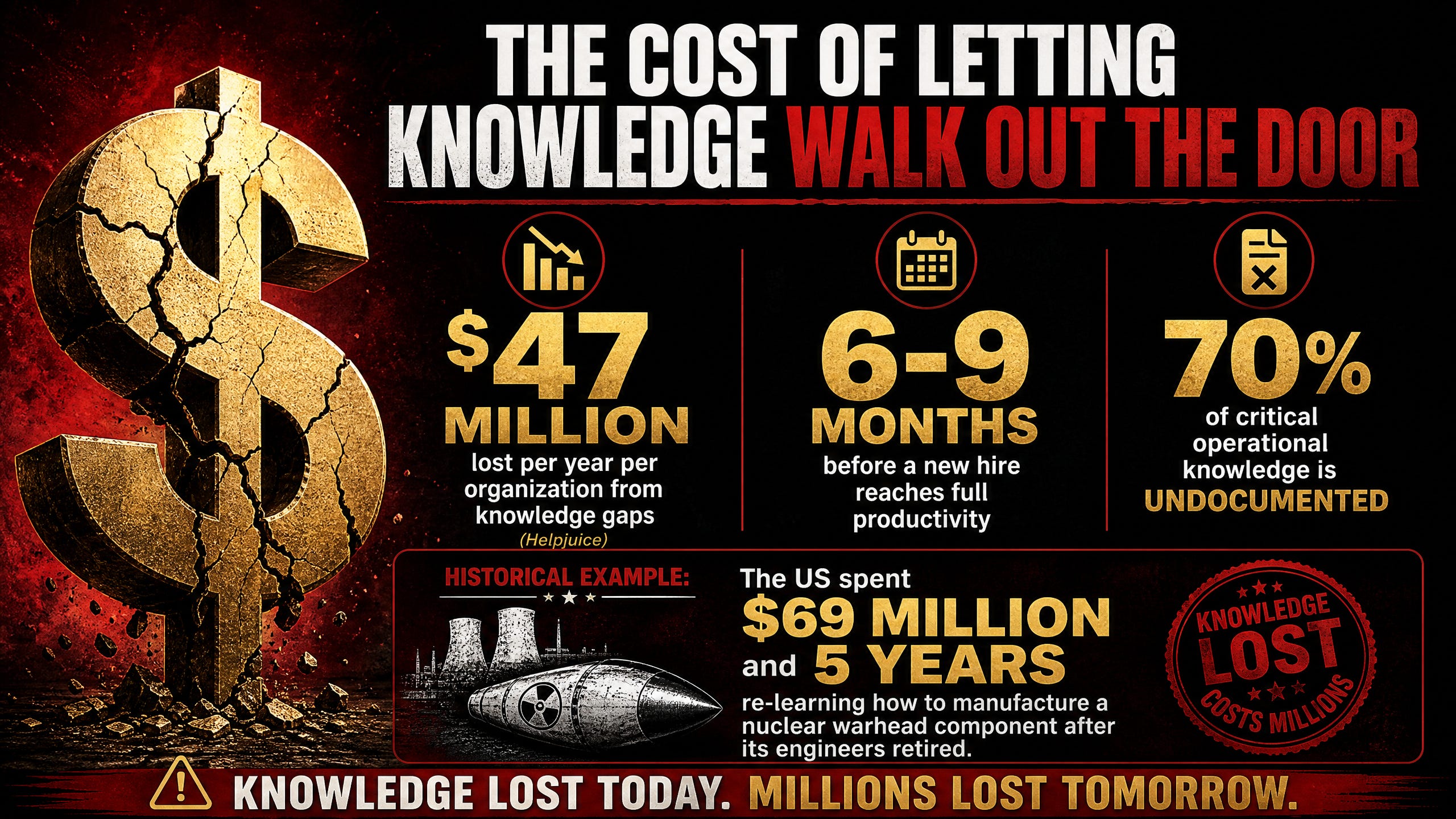
When undocumented, non-scalable expertise walks out the door, the financial impact is catastrophic!
- Research estimates that knowledge loss costs organizations $47 million per year in increased errors, extended training periods, and duplicated problem-solving [5].
- It is estimated that 70% of critical operational knowledge remains undocumented [5].
- When a skilled frontline worker leaves, it takes six to nine months before a new hire reaches full productivity, and the replacement cost can range from 50% to 200% of the role’s annual salary [5].
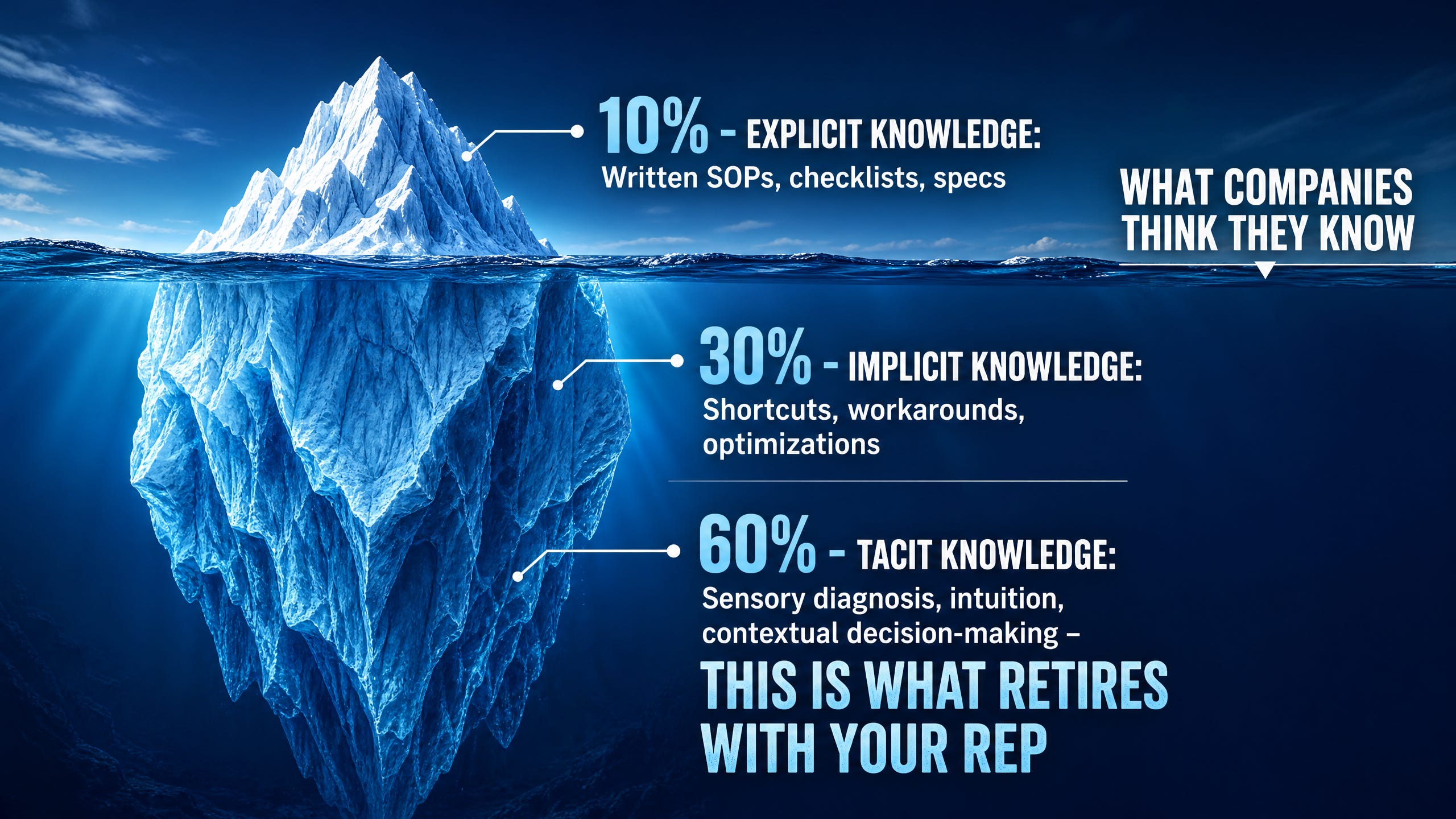
This is a problem of the “Knowledge Iceberg.”
- Most companies only capture the top 10% – the explicit knowledge like written SOPs and checklists.
- They completely miss the 30% of implicit knowledge (shortcuts and workarounds) and the massive 60% of tacit knowledge (sensory diagnosis, intuition, and contextual decision-making) that takes decades to build [5]!
The Digital Playbook: Moving from 1-to-1 to 1-to-Many
To survive the retirement wave, forward-thinking manufacturers and distributors are aggressively digitizing to turn tacit knowledge into explicit digital assets!
Instead of relying on a rep to remember a customer’s specific product substitutions or order frequencies, organizations are deploying specific digital infrastructure.
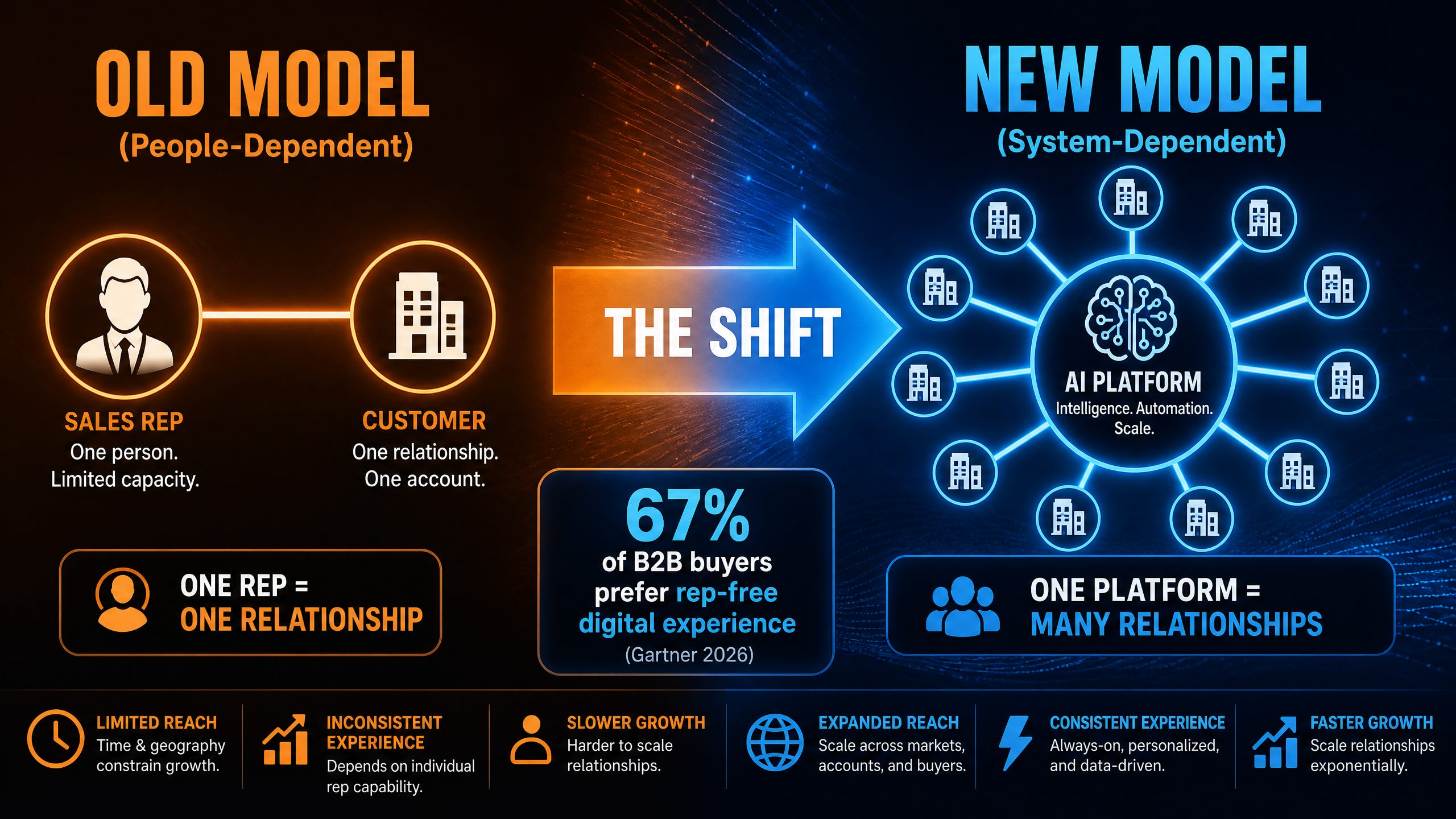
AI first eCommerce platforms & Knowledge Repositories: Leading enterprises are mapping their sales history into unified digital foundations.
According to Deloitte, organizations that centralize disparate sales silos into single, AI-ready knowledge bases cut new-hire onboarding times by 50% [6].
Self-Service B2B eCommerce: Buyers are actively demanding this shift.
- Data from Gartner reveals that 67% of B2B buyers now prefer a rep-free, digital self-service experience [7].
- 71% of B2B buyers are now Millennials or Gen Z
- 75% state they would switch to a supplier that offers a better online buying experience [8].
- Distributors are deploying advanced product configurators and digital sales rooms so clients can re-order complex parts without needing to call “their guy” on his cell phone.
Algorithmic Pricing and Guided Selling:
Instead of an old rep manually quoting a deal based on “gut feeling” or a decades-old handshake agreement, companies are feeding historical transaction records into CRM decision engines.
The software then automatically dictates the optimal “next-best action” and pricing tier for new reps.
The retirement crisis means digitization is no longer just an efficiency play to cut corporate overhead.
It is an existential requirement to ensure that when a top-performing sales rep retires, the customer relationship doesn’t retire with them!”
IST Comment – The footnotes identified in the article are defined at the bottom of the article on his site.
Take Aways
- Jason is 100% right. As further proof, I’ve tracked the acquisitions in the electrical distribution industry. There have been about 135 since COVID. About 125 of them were driven solely by generational change … no family succession for the ownership. Further, in some of those companies, they looked at their leadership team and realized none of them could acquire / lead the company because they were all THE SAME AGE!
- AI can be utilized to pass along knowledge … from every role within a company … and then AI tools can aggregate the information, identify duplication, determine enhancements, and even be a repository of information.
- For your younger / less experienced salespeople who are, hopefully, developing customer instinct’s, look at IDEA”s Data Whispers tool as a way to accelerate this learning / on-site (at the customer) coaching tool. Most companies do poor account-level sales coaching. IDEA has developed a query process that identifies sales and profit improvement opportunities.
- eCommerce, and a strategic digital transformation process, is important, but distribution is still a relationship game for many customers. Having “the right talent” is important. If you need quality people, we recommend talking to GRN Coastal Recruiters. They understand distribution, your challenges, and the industry. And if you need eCommerce and/or product content support, let me know and I can recommend some solutions depending upon your situation.
- As eCommerce, which is broader than website ordering, becomes more important, companies need to appoint someone with the role of eCommerce Strategy. This is responsibility for the commercial strategy … not marketing of the site, not product content, but someone responsible for driving revenue from multiple sources. It could be part of an existing person’s role, but it needs a specific KPI. At the same time, while eCommerce transactions are customer driven, marketing has an increased responsibility for driving demand for products and building brand. Elements of an initiative may include video, AEO, direct marketing (print and digital), events, frequency programs, content marketing and more. In other words, … you cannot “skimp” and avoid these (although AI tools may be more cost-effective and timelier IF you have the right thought process (for prompting / developing) and AI coding mindset.
Operate eCommerce as a business with strategy and clear KPIs. Appropriately resource it and, if necessary, do it in phases.
Is your company aging in place? What’s next?
And if you don’t know Jason, follow him on LinkedIn or, more importantly, subscribe to his SubStack to receive his insights. This is someone that should definitely be a speaker at an upcoming industry event to bring a new perspective to issues that are affecting the industry.


Leave a Reply