
Every company seeks to improve profitability. While you endeavor to price everything correctly with a goal of achieving the desired margin, there are the inevitable. This why the phrase “sh*T happens” was invented. People are not infallible and most people do not make errors on purpose. Sometimes a typo is a typo. Sometimes mistakes occur because of lack of training or lack of frame of reference, or just now knowing.
These are “teachable moments” and are the hallmark of a good manager.
The key is having the discussion (remember, your staff are people too!)
And, while you have discussion, sometimes it is important to document what happened and why to determine if it is something repeatable and then conduct a root / cause analysis as there could be a very justifiable reason that a process, a software change, or training, can address.
What brought the topic up, which is essentially, “how to be a good manager?” Daniel Dinh from Intuilize reached out on the topic, having noticed we’ve shared ideas about improving margin, and shared this on the people side of the business.
People Feedback Drives Process Improvement
“You have had this conversation before.
A branch is consistently pricing below the matrix on a handful of accounts. You address it in a sales meeting. Things tighten up for a few weeks. Then the pattern returns. Same accounts, same reps, same gap between what the system says and what actually ships.
Customer feedback tells you what happened. Financial results tell you what happened. An override tells you what someone thinks is about to happen. That distinction matters more than most operating reviews ever acknowledge.
The same pattern appears in purchasing and inventory: different SKUs, different branches, different explanations. The exception gets approved, the order gets placed, the override gets filed as a deviation, and everyone moves on to the next problem.
What rarely happens is any conversation about what the override was trying to say in the first place.
The Decision Nobody Reviews
Most distributors spend considerable time reviewing recommendations. They spend almost no time reviewing the decisions that replaced them.
The recommendation gets a meeting. The decision that replaced it gets nothing.
That gap persists because the override looks like a closed matter. The exception was approved. The transaction completed. The outcome will show up eventually in the numbers. But by the time it shows up in the numbers, the moment to learn from it has already passed.
What the Override Actually Contains
When a sales rep prices below the matrix to protect an account, they are making a claim about that customer right now, before the order ships, before the quarter closes, before any report reflects it. When a buyer orders above the recommended quantity, they are making a claim about supplier reliability or demand patterns that the replenishment system has not yet registered. When a branch ignores an inventory recommendation, someone in that branch has a reason. That reason exists in the present.
Every other signal arrives from the past.
Every override is feedback. Most distributors discard it.
A pricing exception may reveal a competitor’s new position in an account. A buyer’s adjustment may signal changing supplier behavior before service levels deteriorate. A branch-level inventory override may expose demand patterns that have not yet appeared in forecasting reports.
Experienced people often know the system is wrong long before the reports do. What they rarely do is surface that knowledge in a form the business can use. The override is the closest thing to that conversation most distributors ever get, and it disappears the moment the transaction closes.
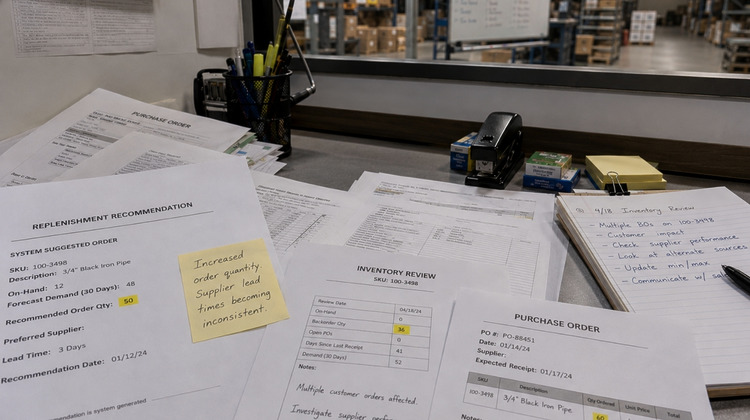
Consider a buyer who repeatedly increases replenishment quantities on a handful of SKUs over several months. Each adjustment gets approved and filed. Noone asks why. Then, months later, a purchasing review surfaces the pattern, and the answer turns out to be supplier lead time variability that the replenishment system had never registered. The buyer was right. The system hadn’t caught up yet. What looked like a string of individual exceptions was a signal. Left unexamined, those overrides pointed toward a planning assumption that needed updating. Reviewed as a pattern, they would have surfaced it months earlier.
What It Costs to Move On
When overrides go unexamined, the damage accumulates in two directions, and neither shows up until it is too late to do much about it.
One possibility: the override was right. The system’s assumptions had drifted from reality. Costs had shifted. A supplier had become unreliable. A customer segment had changed in ways the pricing matrix had not caught up with. When nobody notices, the system stays wrong. Pricing managers keep generating recommendations that experienced reps keep ignoring. Replenishment logic keeps suggesting quantities that buyers keep adjusting. Over time, the gap between what the system recommends and what operators actually do stops being an exception and starts being the real policy. It just never got written down.
The other possibility: the override was a habit rather than a judgment call. The discount had become reflexive. The buffer stock made sense during a disruption and never got revisited. When nobody examines it, the habit compounds. The temporary discount becomes the permanent price. The emergency buffer becomes the new baseline. Leadership sees it eventually, in a margin report or a working capital review, but by then it has been running for months and the window to address it cleanly has closed.
The Conversation That Usually Doesn’t Happen
The conversation that would surface either problem is surprisingly simple. Most operating reviews never have it.
When a recommendation gets overridden, three questions would tell you nearly everything worth knowing: Was the system wrong? Was the person right? Should either become policy?
Most of the time, nobody checked.
Branch managers could ask this about pricing exceptions once a month for a single product category. Purchasing teams could ask it about the SKUs where replenishment recommendations get adjusted most often. It does not require a new system. It requires a deliberate review process.
A single override is a data point. A recurring override on the same account, same SKU, or the same category is a signal. The distinction matters because the response is different. One exception may warrant a conversation. A pattern warrants a question about whether the system’s assumptions still reflect reality. That is where root cause analysis begins.
For smaller distributors, this does not require a formal review process. In many owner-operated businesses, the conversation already happens informally. The question is whether it happens deliberately. An owner-operator who asks why a buyer keeps adjusting the same SKU, and then follows the answer is doing this. The mechanics change at different scales. The question doesn’t.
The override log is not a list of exceptions. It is a record of every moment someone in your business looked at what the system said, knew something the system didn’t, and acted on it anyway.
Was the system wrong? Was the person right? Should either become policy?
Most organizations never ask. The override disappears the moment the transaction closes, and so does everything it knew.”
Daniel T. Dinh develops and publishes pricing and inventory decision governance methods for U.S. mid-market industrial distributors. Connect with him on LinkedIn

While Daniel knows pricing and inventory processes, he recognizes that systems work if they are designed to be people-first while achieving the company’s objectives.


Leave a Reply