
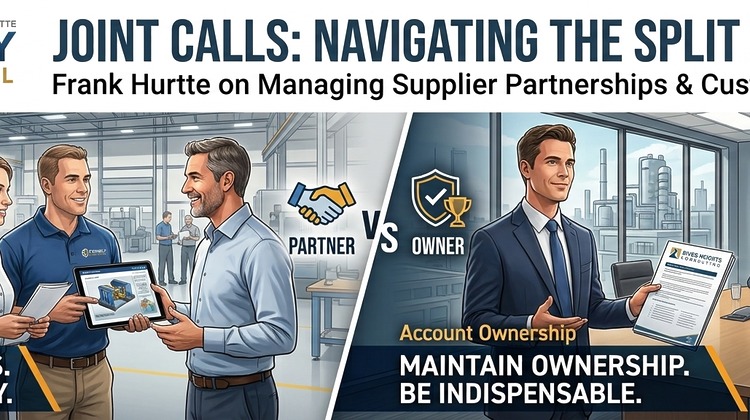
I’ve been thinking about joint calls lately. You know the drill… taking supply-partners out to visit your customers. As I sat down to write about the subject, I found myself conflicted. To the point of wondering if I were developing distributor directed personality disorders. As I sorted through dozens of conflicting thoughts, I even found myself putting a face on the whole issue. Let’s call this salesperson, regional manager, VP, or some other title – Factory Fred.
Factory Fred Wants to Do Joint Sales Calls!
Fred is that supplier salesperson we all know. He rides along on joint calls, sometimes he knows his products, has seen a thousand applications, consumes questionable road food, and occasionally knows more about what could be happening at your customer than you do.
And therein lies the problem.
On one hand, some distributor salespeople hide Factory Fred from important customers and their ability to create future business. On the other hand, handing Fred the keys to the account and hoping everybody (including Freddy) remembers the meaning of “channel partnership” is equally stupid.
So, which of my two thoughts/rants is right? I believe both have merit.
There is risk on both sides. Smart distributors don’t choose between protecting the account and leveraging the supplier. They do both. Use Factory Fred. Keep Factory Fred informed. Let Factory Fred help create opportunities you might never find on your own. But never surrender ownership of the customer relationship.
The best account protection isn’t secrecy. It’s making the distributor so damned valuable that neither the customer nor Factory Fred can imagine doing business without you.
Join me as we stroll down the two separate paths bouncing through my mind.
Thought One: Stop Hiding Your Customers from the Factory
There is a peculiar species of distributor salesperson who believes keeping supply-partner salespeople away from customers is a brilliant account-protection strategy.
It isn’t. It’s downright dumb.
The logic apparently goes something like this: “This is MY customer. If I introduce Factory Fred to them, Fred might develop a relationship. Worse yet, Fred might learn something. Therefore, I will protect my account by keeping Fred safely locked in the trunk.”
Brilliant, but…
While you’re protecting your precious territory, Fred is visiting dozens of other customers. He is seeing applications you haven’t seen. He’s hearing about new technology. He knows what companies in other territories are doing. He knows what his engineering people are developing, which products are approaching obsolescence, and where other customers are spending money. But God forbid we expose our customer to any of that.
Here’s the strategic reality: You need Factory Fred informed about your important accounts.
Not just when you need special pricing. Not just when a competitor is kicking your butt. Not just when you’ve screwed around for six months and suddenly need a factory miracle to drag an order across the finish line.
Fred needs to understand where the customer is going.
What are they building next year? What equipment is aging? What technologies are they evaluating? What problems are engineering and maintenance fighting? Who is making decisions? Who just got promoted? What corporate initiatives are coming down from Mount Olympus?
Why? Because good factory salespeople connect dots.
They hear something your customer says and remember seeing the same situation 600 miles away. They recognize an application you walk past every Tuesday. They may know about new technology your customer hasn’t heard of yet.
That’s how opportunities get created before there is a project ever materializes.
And here’s the stupid part about hiding your customer from Fred: you’re also hiding yourself from Fred. Factory salespeople decide where to invest their time. They know which distributors create business and which ones simply wait around for orders to hatch.
When Fred hears about a project, gets a lead, learns about a new application, or has factory resources to deploy, whose phone rings? The distributor who treats him like a partner? Or the paranoid territorial genius who keeps him locked in the trunk?
Your customer relationship isn’t protected by keeping good people away. It’s protected by making yourself indispensable to the relationship.
Get Factory Fred out of the trunk.
Thought Two: Don’t Be Stupid… Factory Fred Is Not Your Brother
In my other rant, I beat up distributor salespeople who hide their customers from good supply partners. They deserve it. But before the Factory Freds listening in start feeling too warm and fuzzy, let’s discuss the other side of this mess.
Factory Fred is not your brother.
He may be your friend. He may be a great guy. You may have shared 400 greasy burgers together, suffered through regional sales meetings together, and know the names of each other’s dogs. Wonderful. But Fred still works for somebody else and someday Freddy may be gone.
His replacement may have entirely different ideas about your customer. His new VP of Sales may decide distributors are expensive. Some freshly minted consultant may produce a 73-page PowerPoint explaining how going direct will “enhance customer intimacy.”
Translated into Iowa Speak: They want your account.
So, yes, take suppliers on joint calls. But don’t be stupid about it.
Choose Your Friends Carefully
Not every supplier on your line card deserves strategic access to your best customers. Strategic suppliers earn that privilege.
Before opening the doors, distributor and manufacturer management need to iron out and understand the rules. Who owns the account? Who controls commercial activity? What happens with jointly developed opportunities? What happens if the guy down the street wanders into the account armed with a sharp pencil and a price book?
And here’s the question everybody likes avoiding:
What happens if the manufacturer decides to take the account direct?
Discuss that while everybody still loves one another. Don’t wait until somebody smells a few million dollars and suddenly develops amnesia about “channel partnership.”
That’s a conversation for distributor and manufacturer senior management, not Fred and a salesperson over cheeseburgers. If millions of dollars of distributor-created business can disappear with one corporate decision, somebody upstairs better understand the rules before the game starts.
Don’t Abandon the Fort
Here’s another distributor trick that borders on self-inflicted stupidity. Your salesperson leaves. Factory Fred knows the account, so everybody breathes a sigh of relief.
“Fred will keep an eye on things until we hire somebody.” Six months later Fred knows the customer better than anyone working for the distributor. Congratulations. You didn’t lose control of the account. You gift-wrapped it. Then somebody at the distributor starts bitching about supplier loyalty.
Fred wasn’t necessarily plotting against you. He protected his business while you left the driver’s seat empty. Important customers must have multiple relationships inside the distributor. Management, specialists, inside sales and others need connections there.
Never allow one departing salesperson to take your entire customer relationship with them.
Watch What Fred Does
Good partnerships require trust. They don’t require blindness. It’s the old “trust but verify” adage revisited.
Is Fred suddenly visiting without you? Talking commercial terms directly with purchasing? Asking for information that has nothing to do with helping the customer? Leaving you off emails? Calling the place “our account”? Is another distributor mysteriously sniffing around business you developed?
One incident might be nothing. Three is a pattern. Ask questions. And, if the answers stink, move upstairs quickly. Strategic partnership doesn’t mean smiling politely while somebody picks your pocket.
Make Yourself Damn Hard to Remove
Ultimately, contracts, account-registration systems and executive agreements help. But your greatest protection is value. If all you contribute is an invoice, don’t be shocked when somebody asks why they need you.
Create opportunities. Solve problems. Carry inventory. Provide expertise. Reduce work. Know the applications. Know the people. Make things happen.
Let Factory Fred know the customer. Just make damned sure everybody understands why you belong in the middle.
Hiding the customer is defensive selling. Handing over the customer is stupid selling.
Making yourself indispensable is strategic selling … and being strategic drives profits.


Leave a Reply