
Grainger 3Q 2026 Earnings at a Glance
Grainger reported 3Q 2026 results on November 4, with sales of $5.2 billion, up 11.3%, or 14.9% on a daily, organic constant currency basis). Grainger achieved operating margin of 16.1% on a reported basis, up 90 basis points y-o-y. Grainger’s gross margin increased 20 bps to 38.8% y-o-y and gross profit was $2.01 billion, up 11.8%.
While much of the industrial distribution sector remains focused on the AI-driven data center boom, Grainger’s 3Q 2026 results demonstrated something broader and arguably more important – healthy demand across North American maintenance, repair, operations (MRO), manufacturing, commercial facilities, government customers, and infrastructure markets. Unlike many distributors benefiting from a single end-market, Grainger delivered strong growth across both of its major business models.
CEO D.G. Macpherson highlighted continued execution across Grainger’s customer base and successful delivery of products and solutions despite ongoing inflationary and supply-chain pressures.
Segment Performance: High-Touch Solutions and Endless Assortment
Following the exit of the U.K. operations in 2025, Grainger has become even more concentrated in North America, making its results particularly useful as a gauge of U.S. industrial demand. The company’s core North American business continued benefiting from data center construction and operations, manufacturing activity, commercial facility spending, strong healthcare spending, government demand, institutional markets, infrastructure-related projects. Let’s take a closer look at the performance of the two operating segments:
High-Touch Solutions – North America (HTS-NA)
- In the High-Touch Solutions – N.A. segment (HTS-NA) – typically “in-plant” and serving the Fortune 500 companies and most comparable to an electrical distributor’s standard customer, and accounting for 80% of Grainger’s revenue in the quarter – sales rose 13.8% both reported and on a daily, constant-currency basis. The core drivers were double-digit volume growth, strong growth across all key markets (particularly data centers and power generation), customer retention, expanded product categories, inventory management and technical support, including recent AI/computer‑vision inventory management acquisition aimed at reducing customer labor costs and improving operational efficiency. Gross margins in HTS saw slight compression, down 30 bps to 40.8%, due to freight headwinds and a shift toward project‑related spend, but overall operating margin expansion of 90 bps was supported by top‑line leverage and the prior‑year UK exit. The broad-based demand is shown by the sector breakdown of sales from the earnings presentation:
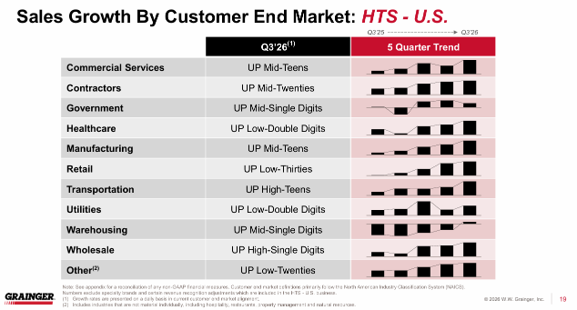
Grainger’s U.S. performance reflects strong fundamentals across the board and healthy MRO demand across industrial verticals. While Grainger is not a primary supplier to hyperscale data centers (unlike Wesco or manufacturers like Eaton Schneider and Legrand), data‑center construction indirectly boosts MRO demand for (tools, safety, consumables, electrical supplies – much from Endless Assortment), contributing to broad-based volume growth in High‑Touch Solutions.
The fluid geopolitical situation and resulting cost pressures are a focus as Grainger increased prices in September to address ongoing inflationary pressure. The Main driver was increased input costs due to conflict in Middle East, particularly on safety and PPE products derived from petrochemicals (e.g., nitrile gloves). Freight cost inflation was repeatedly cited as a headwind during 3Q and expected to pressure margins in 4Q. Management also cited ongoing inflationary pressures from labor, sourcing, and distribution operations. Tariffs remain a factor throughout the distribution supply chain and management discussed continuing pricing activity and supplier engagement to offset tariff-related cost impacts while protecting customer value propositions. The September pricing actions addressed all known product cost inflation and tariffs impacts and there is another round of pricing actions planned for January primarily driven by the ongoing freight headwinds.
Endless Assortment (MonotaRO and Zoro)
- In the Endless Assortment segment (MonotaRO, Zoro), what could be called, “non-Grainger branded” and historically small and mid-sized customers who purchase periodically, sales increased 11.9% to $1.05 billion, and daily organic revenue grew 19.3%, with Zoro U.S. sales up 25.2% on a daily basis, fueled by deeper engagement with core B2B customers and enhanced marketing capabilities. MonotaRO’s local currency sales grew 13.6% despite seasonal prebuy headwinds. Gross profit margin increased 90 bps to 31% driven by Zoro’s discount strategy change and favorable product mix across the segment. Operating margin increased 190 bps driven by gross margin flow through and sales leverage across the segment.
Shareholder Concerns on Growth, Margins and Technology
Investors questioned whether nearly 15% organic growth is sustainable. Management attributed growth to market-share gains, strong execution, customer retention, and ongoing demand across multiple end markets. Rather than citing short-term project activity, Grainger emphasized structural share gains and customer-value improvements.
Analysts focused heavily on future margins, and management acknowledged several headwinds including freight inflation, incentive compensation, and increased operating costs. Offsetting actions include supplier rebates, pricing actions, and productivity improvements. In particular, investors sought reassurance that the Endless Assortment model can continue growing profitably. Management highlighted improving acquisition costs, customer retention trends, and operational efficiencies as supporting future margins.
There was discussion on whether Grainger’s technology acquisition would generate acceptable returns. Management expressed confidence that AI-enabled computer vision and inventory management capabilities will strengthen customer relationships and broaden Grainger’s service offering without requiring disproportionate investment.
Raised 2026 Guidance
Following a strong quarter, Grainger raised guidance again, with sales growth now projected in the 13% to 14.5% range and operating margin in the 16% to 16.2% range. The guidance increase was supported by strong demand trends, market-share gains, better customer retention, and continued execution in HTS and the strong performance in Endless Assortment.
Intriguing Questions for Industrial Distribution
Grainger’s performance raises some intriguing questions….
- Does Grainger’s nearly 15% organic sales growth reflect a favorable industrial spending cycle and are the market share gains sustainable?
- If U.S. manufacturing growth slows in 2027-2028, can Grainger still outgrow the market?
- Grainger is increasingly winning because of scale, inventory availability, digital capabilities and analytics, technology integration, and strong national account programs. Can Grainger continue consolidating share from thousands of regional and local distributors?
- Is Grainger simply supplying maintenance products into data centers and can it become an increasingly strategic supplier throughout construction and operations?
- Is Grainger becoming a technology company disguised as a distributor? Does Grainger’s competitive advantage increasingly come from software and workflow integration rather than product distribution? If customers become deeply integrated into Grainger’s inventory-management ecosystem, switching costs rise significantly and customer retention should improve. This could fundamentally change the economics of industrial distribution.
- Can Zoro eventually achieve margins closer to the High-Touch Solutions business?
- Can Grainger maintain double-digit sales growth once pricing becomes a much smaller contributor and inflation normalized?
- Can Grainger defend margins as competition intensifies and catches up digitally? Grainger’s operating margins remain among the strongest in industrial distribution, reaching roughly 16%. The long-term challenge is maintaining those margins while Amazon Business expands, digital competitors improve, large customers demand concessions, labor costs rise and freight inflation persists.
- Will AI allow distributors like Grainger to improve inventory turns, increase customer retention, and reduce cost-to-serve faster than competitors? If so, industry leaders could widen the gap versus smaller distributors throughout the next decade.
Implications for Other Distributors
Grainger’s quarter sends several important signals for the industry. Unlike distributors heavily exposed to a single market, Grainger serves a broad cross-section of the economy. Its strong quarter suggests manufacturing and facility spending remain healthy. Data centers are certainly helping, but in the case of Grainger, are not driving everything and growing volume is the story.
Grainger’s investments in AI, computer vision, inventory management, and digital commerce underscore a broader industry shift toward technology-enabled distribution.
Grainger’s Q3 2026 results showed a distributor firing on nearly every cylinder. Organic sales grew 14.9%, guidance was raised again, and both the High-Touch Solutions and Endless Assortment businesses delivered strong execution.
While tariffs, freight inflation, and cost pressures remain challenges, management’s commentary suggests the U.S. industrial economy remains healthier than many investors expected. For the broader electrical products and distribution industry, Grainger’s results reinforce three themes that have defined 2026: strong North American demand, accelerating digital transformation, and continued growth opportunities tied to infrastructure modernization and AI-driven investment.


Leave a Reply