

In the industrial supply industry, where organic growth is there but slugg(ish), distributors are increasingly aggressive about “buying support”. This is especially true in unseating competition that operate MRO storerooms or are doing “vendor managed inventory” initiatives for industrial accounts. Market share for distributors isn’t just earned like it used to be—it’s bought. But for the distributor, “buying” that share often comes with a heavy trail of legacy inventory that can choke a balance sheet, which leads to the long-tail version of parts.
(And as an aside, this concept was started by manufacturers (and continues) and is a core component of them “earning” conversions from a distributor. Manufacturers frequently buy-back a competitor’s inventory so that they can get the distributor to convert to their brand.)
Conversions as a Sales Opportunity, and Converting the Sales Expense Into Liquidity
Back to the distributor …
Sitting on long tail parts is exactly what a distributor is trying to avoid.
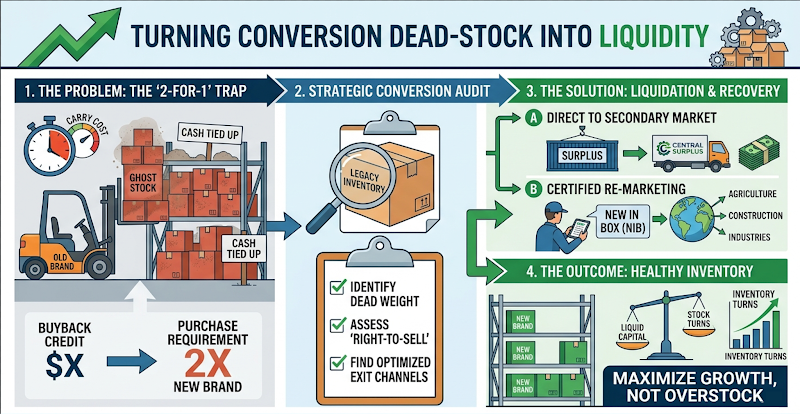
To win a plant’s loyalty, a manufacturer, through a distributor, may offer a conversion buyback. They credit the end-user for their legacy-brand spares in exchange for a new-brand rollout. The catch? The 2-for-1 ratio. For every $1 of competitive scrap credited, the end-user must often purchase $2 of new product. While the C-suite & Sales sees a sales win, the warehouse manager sees a growing pile of ghost stock—high-quality, NIB parts that the distributor is now contractually or practically unauthorized to sell through standard channels. The manufacturer should financially support the distributor but, the warehouse manager is still left with more inventory … that cannot be sold!
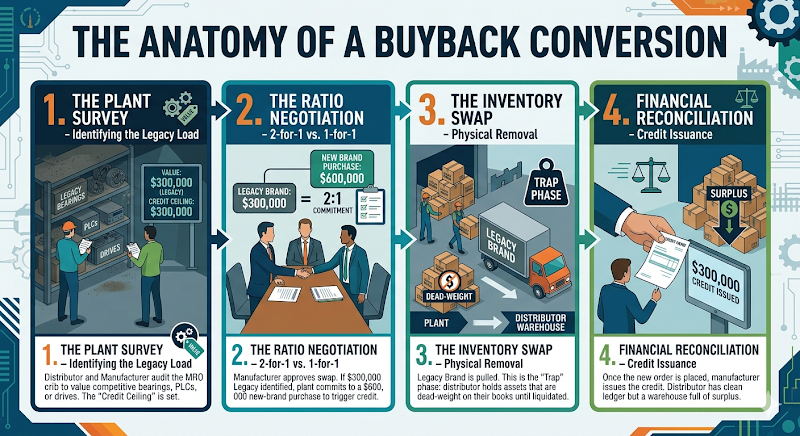
1.The Plant Survey – Identifying the Legacy Load
The distributor and manufacturer audit the MRO crib to value competitive bearings, PLCs, or drives. The “Credit Ceiling” is set.
2. The Ratio Negotiation – 2-for-1 vs. 1-for-1
The manufacturer approves the swap. If $300,000 of Legacy Brand is identified, the plant commits to a $600,000 new-brand purchase to trigger the credit.
3. The Inventory Swap – Physical Removal
The Legacy Brand is pulled. This is the “Trap” phase: the distributor now holds assets that are technically dead-weight on their books until liquidated.
4. Financial Reconciliation- Credit Issuance
Once the new order is placed, the manufacturer issues the credit. The distributor is left with a clean ledger but a warehouse full of surplus.
Strategic Advice for Industrial Professionals
- Don’t Let it Sit: Legacy stock isn’t bad product—it’s just no longer fast-moving. However, Supply Chain 24/7 highlights that the longer this stock sits, the higher the Inventory Carry Cost in a high-interest environment (and let’s be honest, anything over 0% means it is costing you money!)
- Leverage Secondary Markets: Savvy distributors (and even manufacturers) partner with non-competing surplus buyers to offload conversion stock immediately. This converts physical legacy parts back into liquid capital before they become paper weights.
- Audit Your “Right to Sell”: Ensure you have a clear path to move buyback items. If the manufacturer requires destruction, negotiate for “re-marketing” to recover at least the freight and handling costs.
The lowest line on the balance sheet: converting customers to your preferred brands is essential for generating growth, but it is an inventory trap if you don’t have an inventory exit strategy. Turning that ghost stock into cash is the difference between a profitable quarter and a warehouse full of regret.
Negotiating a 1-for-1 buyback ratio is essentially asking a manufacturer to subsidize your market share gains without the typical “growth premium.” In our 2026 economy where inventory carrying costs are at ATHs, the difference between a 1-for-1 and a 2-for-1 ratio can be the difference between a liquid win and a three-year storage headache.
To get to 1-for-1, adjust the conversation from clearing the shelf to capturing the lifetime value of the account.
High-Leverage Negotiation Tactics
1. Leverage the “New Standard” Exclusivity
Manufacturers want more than just a one-time order; they want to be the standard. If you can guarantee that the end-user is stripping out all competitive stock and committing to a 3-year exclusive supply agreement, the manufacturer is much more likely to eat the cost of a 1-for-1 swap.
- The Pitch: “We aren’t just selling $300k of product today; we are locking out Brand X for the next 36 months. We need a 1-for-1 to make the transition cash-neutral for the client.” (copy this, seriously)
2. Offer “Destruction Certification” or Secondary Channel Control
Manufacturers often fear that buyback stock will end up back on the “grey market,” competing against their own new sales. You can lower their risk (and improve your ratio) by providing a certified liquidation plan, where the buyers operate in the least-competitive format.
- The Move: Offer to move the legacy stock through a surplus partner who can ensure the parts are sold into non-competing industries or geographic regions, protecting the manufacturer’s primary price integrity, and protecting them from being concerned that you may sell it to another customer (if you also sell the competing line … perhaps at another location!)
3. The “Stocking Profile” Trade-off
Offer to increase your ongoing stocking levels of the new brand’s high-margin A items in exchange for the 1-for-1 credit on the conversion.
- The Math: Manufacturers love inventory depth in the channel. If you agree to increase your permanent floor stock of their flagship MRO products by 15%, they will often waive the 2-for-1 requirement on the initial competitive swap.
4. Bundle with Service & Installation
If the distributor is providing the labor for the swap-out (the physical removal), use those soft costs as a negotiation lever.
- The Argument: “We are absorbing $50,000 in technician labor to facilitate this brand flip. We need you (the manufacturer) to meet us halfway by dropping the buyback requirement to 1-for-1.”
Pro Tip: Always lead with macro reality. Remind the manufacturer that with current interest rates, neither you nor the end-user can afford to park capital in a 2-for-1 requirement.
In an era where capital efficiency defines the winners, letting a “sales win” clutter your warehouse with legacy ghost-stock is a rookie mistake. By pivoting the negotiation from a simple transaction to a long-term market-share play, you transform a potential inventory liability into a high-velocity liquid asset.
The most successful distributors aren’t just selling the future—they are ruthlessly monetizing the past.
Brandon Kelley is an entrepreneur in MRO. His surplus company has purchased more than $500M in inventory, has been to hundreds of DCs, and helps distributors, manufacturers and OEMs recover the highest prices on surplus stock, while remaining the least competitive.


Leave a Reply