
Grainger probably has more eCommerce experience than any distributor. I remember back when they acquired a stake in MRO.com to form FindMRO.com. People thought they were crazy. In reality, it was probably a great experience from a learning perspective.
They’ve built an eCommerce machine that also enables them to power Grainger.com and Zoro.com but also is the backbone of the punchout / catalog services that support their key accounts. And it is why such a high percentage of their business is conducted electronically.
It’s a business mentality.
A key component of it is product data. One area of ongoing interest is “how to get new products online faster?”
In this article from Matt Christensen from Distributor Data Solutions, he shares why this is important, how Grainger addresses it, and how you can too:
How Manufacturers Get Products Onto Grainger Faster
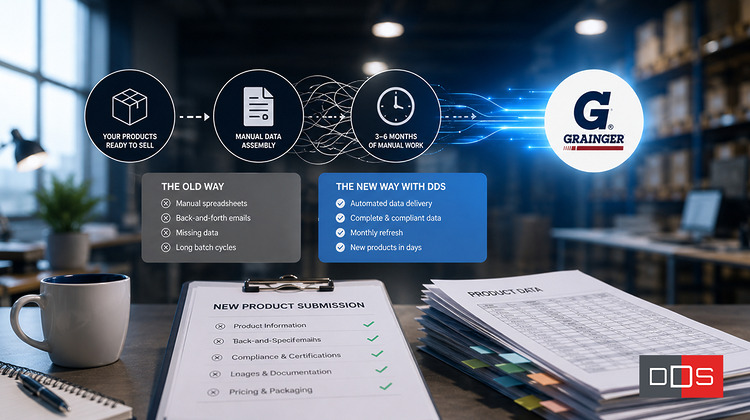
“If you manage the Grainger relationship for a manufacturer, you already know the pattern. You have products ready to sell. Grainger wants them. And somewhere between those two facts sits a process that can stretch from three to six months per batch—most of it spent moving data by hand.
This isn’t a Grainger problem, and it isn’t a you problem. It’s a data problem. And it’s one of the most solvable bottlenecks in industrial distribution.
Why getting onto Grainger is so manual
Grainger is one of the most data-rigorous distributors in the industry. Their catalog is how they go to market, so their requirements are specific: compliance fields, certification attributes, category-level taxonomy that varies by product type. Get a field wrong—a wattage, a country of origin, a package dimension—and it surfaces on the website as an error a customer sees.
The trouble is that the data a distributor like Grainger needs rarely lives in one place. Some of it is in your ERP. Some is in your PIM. Some is in marketing’s digital asset system. Some—like country of origin—may not be in any system at all, and lives with one person who has to be emailed every time. Pulling all of that together into Grainger’s format means running reports, copying, pasting, and hunting down the gaps by hand, for every batch.
So, most manufacturers do what they can to keep it tolerable: submit 40 to 50 SKUs at a time, wait for approval, then start the next batch. When the goal is to grow from a few hundred products to a few thousand, that cadence becomes the ceiling on how fast you can sell.
Where the time actually goes
It helps to separate the delay into two halves, because they have different fixes.
On the manufacturer’s side: gathering the data, filling out Grainger’s forms, responding when Grainger comes back asking for additional attributes once they realize a product is, say, a lighting fixture and now needs lumens and color temperature. Each round trip resets the clock.
On Grainger’s side: reviewing the submission, requesting missing information, assigning part numbers, and finally publishing. Their teams have manual steps too, which is part of why batch sizes stay small.
The manual data work is the half a manufacturer can actually attack. And that’s where syndication changes the math.
What syndication actually changes
Here’s the part worth understanding clearly, because it’s commonly misunderstood: syndication through a delivery platform like DDS does not replace your entire Grainger process. One step stays with you. The rest comes off your plate.
What stays with you: the PAC form. Grainger’s PAC form sets up new products with Grainger-specific pricing and kicks off their internal approval. Pricing doesn’t live in a syndication platform, so this step remains the manufacturer’s. It’s what tells Grainger “yes, we’re going to sell these.”
What comes off your plate: everything after approval. Once products clear the PAC form, Grainger no longer needs to come back to you for data. They pull it directly from three standardized export files maintained on your behalf:
- A taxonomy attributes file—the category-level attributes Grainger requires.
- A transactional file (the NPI)—the core product information.
- A digital assets file—images, documents, and downloads.
These files are built once, kept current, and refreshed to Grainger on a monthly cadence. Grainger’s team has worked with the format for years and knows exactly how to use it—which is a meaningful part of why it moves faster.
The rules engine: how required-but-missing fields stop blocking you
A large share of the back-and-forth comes from required fields a manufacturer can’t always populate. Grainger requires a value; you don’t have one; the file gets rejected; the cycle restarts.
A syndication platform solves this with rules. Where a field will always be the same answer for your products—a compliance attribute that simply never applies, for example—a rule populates it automatically on every export, so nothing gets rejected for a blank a human would otherwise have to fill in by hand each time. Where the data genuinely doesn’t exist, that gets flagged once and handled, rather than rediscovered batch after batch.
And because a delivery platform is doing this across many manufacturers, it carries useful weight in the other direction too: when requirements are heavier than they need to be, that pattern gets fed back to Grainger, and requirements get loosened where it makes sense. That benefits every manufacturer sending data the same way.
The category-review loop, handled
Periodically Grainger runs a category review, checking products against the attributes they expect and reaching out when something’s missing. With syndicated data, that check runs against your export files first. When a genuine gap surfaces, it’s added to the feed once—so the same question doesn’t come back the next time the category is reviewed. The gap closes permanently instead of recurring.
What the time savings look like
The headline most manufacturers care about: new-product onboarding that took around three weeks drops to two or three days once data flows through DDS. The work Grainger’s team would otherwise spend chasing and assembling data is already done—the data is there, in the format they expect, complete.
There’s more on the horizon. Separate from any new batch you submit, the monthly refresh means Grainger’s team always has current data to work from.
It’s also worth knowing that Grainger tends to prioritize manufacturers whose data arrives through a recognized syndication path. When the data is complete and correctly formatted, it’s simply easier to move through their systems—so it moves.
The bottom line
The slow part of selling more through Grainger usually isn’t the selling. It’s the data plumbing underneath it: the spreadsheets, the copy-paste, the rejections, the re-asks. Syndication doesn’t touch the parts that should stay yours—your product strategy, your pricing, your PAC form. It takes the manual data assembly off your team and turns a three-to-six-month batch cycle into something that runs in days.
If growing your Grainger catalog has been gated by how fast your team can move data by hand, that gate is removable.”
Take Away for Distributors
While Matt is writing to Grainger manufacturers, the thought for distributors should be “how can I be like Grainger?”
- How can I get high-quality data to power by eCommerce platform?
- How can I get new SKUs onto my platform from my suppliers quickly?
- How can better product data benefit my customers? (and me through more sales!)
The key is a good data source. If this is an area you are “challenged,” I’d suggest reaching out to DDS. They have data specifically for the industrial supply channel (and gather data from most manufacturers)
Are You a Manufacturer Selling to Grainger?
Now, if you are a manufacturer who sells to / through Grainger, you should be asking yourself a number of questions, first of which, how is my product data getting to Grainger, are we having delays, and what can we do about it.
Matt provided some FAQs for Grainger’s manufacturers
Does syndication replace the Grainger PAC form?
No. The PAC form stays with the manufacturer. It sets up new products with Grainger-specific pricing and starts Grainger’s internal approval, and pricing doesn’t live in a syndication platform. What syndication removes is everything after approval—once products clear the PAC form, Grainger pulls the rest of the data directly from standardized export files rather than coming back to the manufacturer for it.
How long does it take to get new products onto Grainger through DDS?
Manufacturers managing the process manually often see batches take three to six months. Once data flows through DDS, new-product onboarding typically drops to two or three days, because the data Grainger needs is already complete and in the format their team expects.
What happens when Grainger requests an attribute that wasn’t provided?
Grainger periodically runs category reviews, checking products against the attributes they expect. With syndicated data, that check runs against the manufacturer’s export files first. When a genuine gap surfaces, it’s added to the data feed once—so the same request doesn’t recur the next time that category is reviewed.
What if a manufacturer can’t provide a required field?
There are two paths. Where a field will always have the same value for a manufacturer’s products, a rule populates it automatically on every export, so a blank never causes a rejection. Where the data genuinely doesn’t exist, it’s flagged once and handled, rather than rediscovered batch after batch.
How is this different from other syndication services?
For Grainger specifically, DDS is a recognized data provider and works with Grainger’s team on an ongoing basis to streamline the pipeline. More importantly, the goal isn’t simply to add another data feed—it’s to measurably speed up onboarding on both the manufacturer’s side and Grainger’s side, which is often what determines whether new products sell or sit.
Learn more about how DDS delivers manufacturer product content to Grainger and 400+ other distributors—schedule a walkthrough.


Leave a Reply