
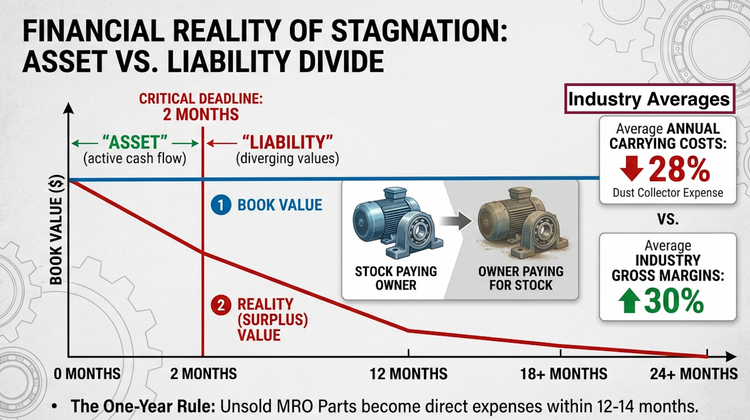
In 2009, my construction company was hired by an MRO and industrial electrical distributor for a warehouse renovation project.
The owner knew exactly what he wanted, we were in constant, direct contact. As we built a working relationship, I started asking questions about the mechanics of industrial distribution—the supply chain dynamics, manufacturer relationships, logistics, and inventory management.
It was captivating. Before long, our daily conversations shifted to a recurring theme: the dead-stock problem.
Intrigued, I started studying the industry from the outside looking in.
It quickly became clear that even the most successful distributors were experiencing a specific, chronic type of financial pain: carrying inactive inventory that bled money every single day it sat on a shelf.
After deeply analyzing the market, I decided to leave the construction industry and try industrial distribution. Frankly, swinging a hammer in below-freezing temperatures was losing its appeal.
That owner recognized my drive and gave me my first real opening: I would purchase his inactive, slow-moving inventory and attempt to move it myself.
And try I did. It was extremely difficult.
But I was hooked. Determined. My mind was made up that it would work out.
Stubbornness eventually paid dividends. With a small amount of traction and break-even metrics, Central Surplus was born in 2010.
Fast forward to 2026. My team, wife, and I have built remarkable relationships with asset recovery managers, investment recovery teams, directors of inventory, inventory managers and CFOs across the sector, helping hundreds of distributors, manufacturers, OEMs, MROs and end-users successfully move over $500M in dead-stock.

Central Surplus is built around Stock Problems
ITR and ERP Hallucination
Over the past 16 years, I have been invited into the back offices of some of the largest OEMs and distributors in the country. I’ve sat alongside seasoned inventory managers as they pull up their ERP systems to show me the supposed “book value” of their stock.
What counts is “reality value”.
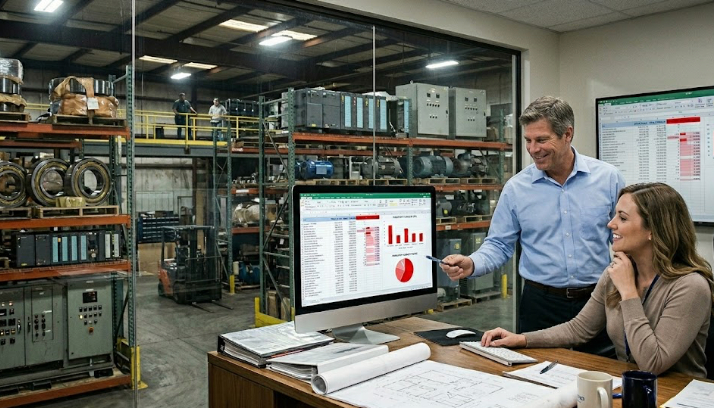
Let’s say a software screen indicates a batch of PLCs or bearings is worth $100k. It’s only worth that $100k if an actual buyer is willing to cut a check for it today, or in the immediate future.
Through years of boots-on-the-ground experience, I’ve learned to spot the difference between a true asset and a stagnant liability. For some organizations, it requires a psychological mindset shift to understand that a part is only a true asset if it aligns with a healthy Inventory Turnover Ratio (ITR) of 7 to 8 turns per year.
What I routinely uncover is a widespread, almost normalized issue with how inventory is tracked—or, more accurately, how it isn’t. Many companies simply do not track their ITR. In some cases, they don’t even possess the clean data required to run the calculations. They are operating completely in the dark, relying on what I call ERP Hallucination.
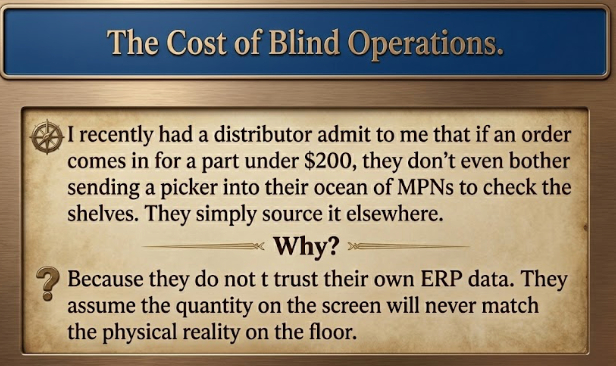
An ERP is only as reliable as the data fed into it. When we conduct physical walkthroughs of industrial warehouses, we typically find only about 76% data accuracy relative to what is actually on the shop floor.
The Financial Reality of Stagnation
This lack of data trust inevitably breeds a JIC mentality, severely bloating the balance sheet. This stock or buffer stock quickly transforms into dead inventory that the owner is paying to house, rather than inventory that is actively paying the owner.
When an MRO part or component sits unsold for more than two months, its reality value begins to sharply diverge from its book value. It ceases to be an asset and becomes a liability consuming high-value floor space and opportunity cost.
The simple math:
- Average Annual Carrying Costs: 28%
- Average Industry Gross Margins: 30%
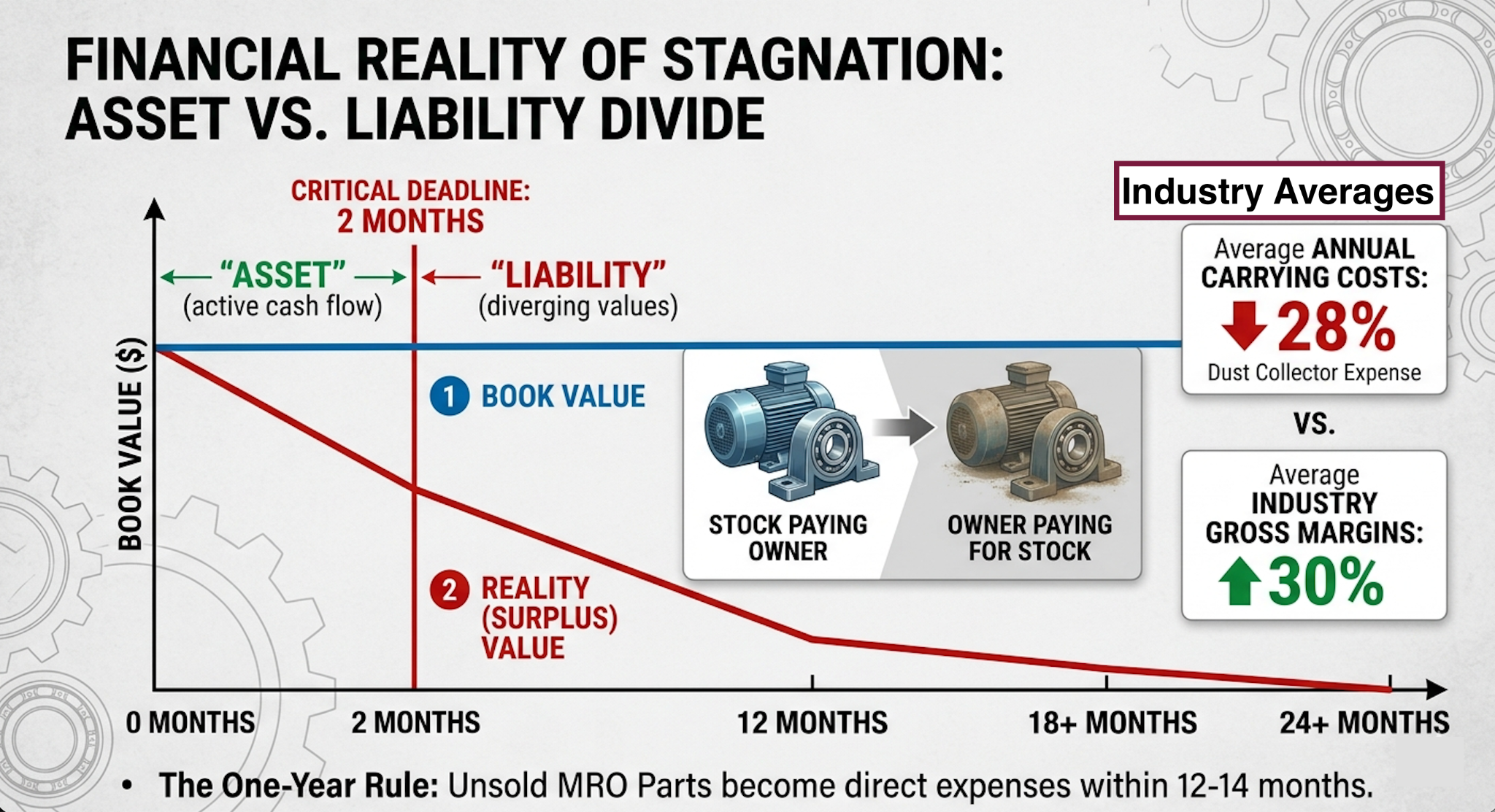
For the vast majority of industrial distributors, a part that fails to move within 12 to 14 months moves from profit-maker to direct expense.
A prime example of this widespread bloating is the trailing effect of the bullwhip phenomenon.
The aggressive over-stocking cycles following COVID left countless companies holding massive excesses that standard procurement cycles simply cannot flush out. Whether driven by product obsolescence automation or the structural fallout of M&A rollups, that inventory eventually becomes a dust collector.
There are many other ways a part turns into a liability. The lifecycle of industrial assets vary by sector.
But parts simply end up not selling – no matter how good a firm’s analytical competence.
It is an operational reality that frustrates everyone from shop floor managers to finance directors. While maintaining in-stock availability for your core clients is non-negotiable, knowing precisely when to cut bait on stagnant lines is key.
A Discrete Exit Strategy
The single most common reservation I hear from the C-suite regarding liquidation is the fear of channel conflict. They are rightfully protective of their primary markets and do not want their excess appearing in their own geographic backyard, competing with their current sales channels.
We solve this problem entirely by acting as a discrete, non-competitive partner for asset recovery; whether it’s your inventory or your customers.
When we purchase an inventory lot, we typically move it completely out of the domestic territory.
Over 90% of the inventory we acquire is distributed directly into international markets—frequently to legacy industrial plants overseas where these components are vital to keeping older infrastructure operational.
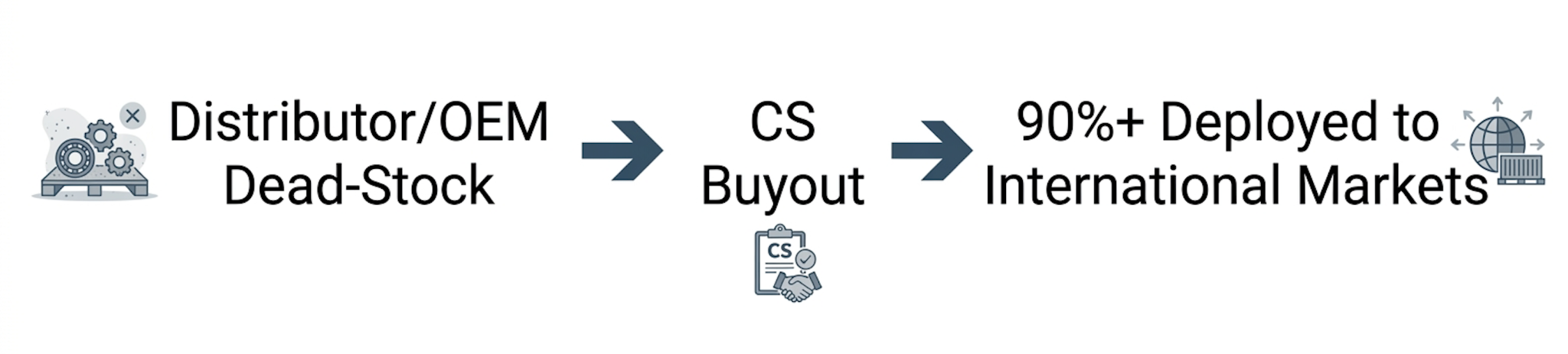
It is a true cliché win-win-win scenario. The domestic inventory owner recovers immediate cash and reduces tax exposure; the international buyer secures the part required to prevent downtime; and the planet benefits from significantly reduced industrial waste.
8,000 Square Feet in 80 Hours
Most inventory owners want to resolve their stock issues, but simply lack the bandwidth or man-hours required to manage the operational headache of a massive liquidation. They need an asset recovery partner who instantly recognizes the technical and market value of Tier-1 industrial brands and critical spares and who can execute at speed.
I recently received an urgent call from an inventory manager at a major renewable energy OEM. They didn’t know me, but they were sitting on 8,000 square feet of high-value electromechanical parts and automation controls that required immediate relocation. I flew out the next morning to personally assess the lot.
This industry appreciates an in-person meeting with a lunch and handshake.
After a quick run through our pricing tools and an accepted offer, our team handled the entire pack-out from start to finish:
- palletized the inventory
- staged it on-site
- coordinated the logistics
- paid immediately
Within days, the space was clear. The client successfully recovered their capital, reclaimed their much needed warehouse square footage, and chilled knowing the inventory was routed overseas, removing risk of local or open market competition.
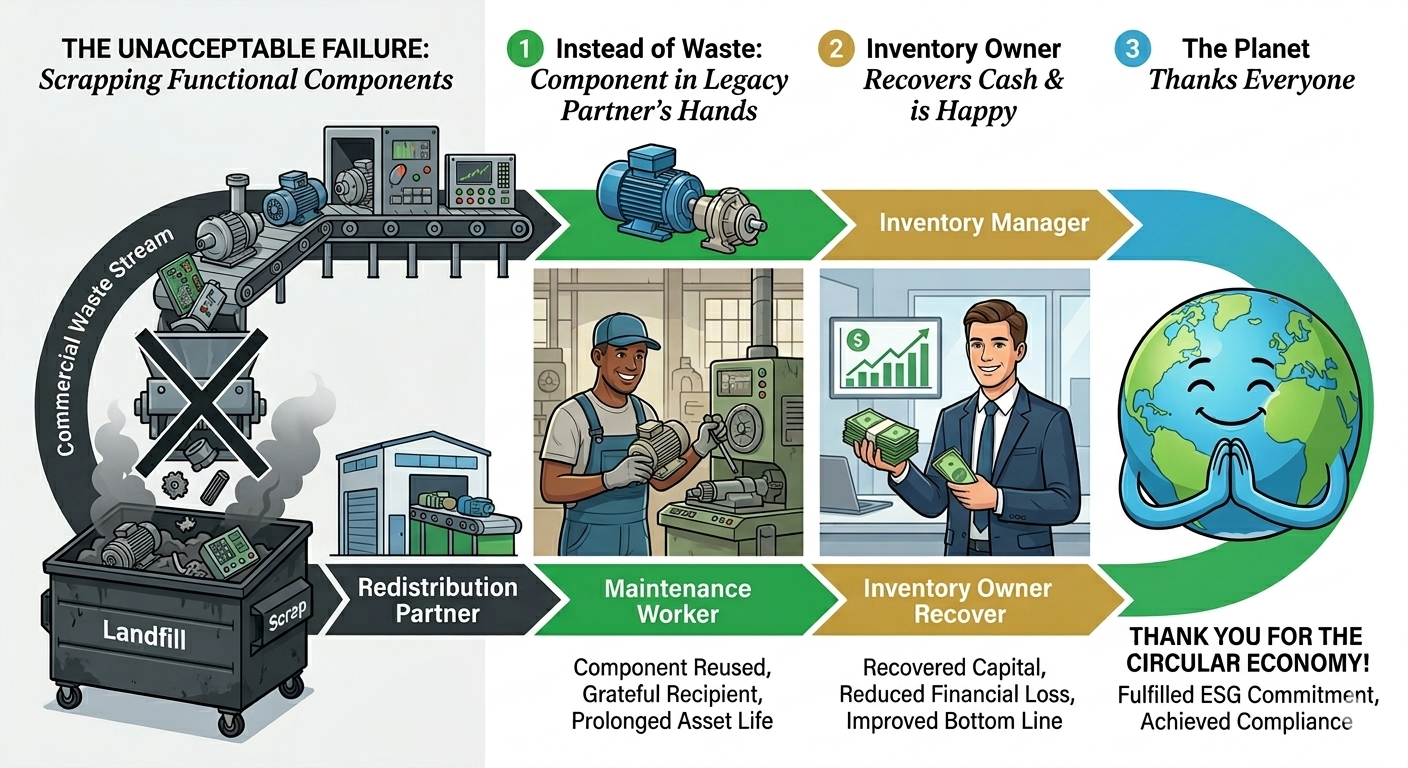
Beyond the financial benefits, there is a growing mandate for ESG compliance. In modern corporate operations, scrapping new, fully functional industrial components is an unacceptable environmental failure.
By choosing a redistribution partner over the commercial waste stream, companies can directly align their inventory disposal policies with their corporate sustainability goals. It allows inventory owners to recover real capital while fulfilling their commitment to a circular economy—achieving environmental compliance without sacrificing the bottom line.
Fresh Cash, Zero Friction
Central Surplus was founded to solve the inefficiency of industrial waste—not just physical waste, but financial waste.
Inactive inventory is a line item on a balance sheet that is currently underperforming.
Most companies view excess inventory as a liability—it occupies high-value floor space and ties up capital. But we aren’t just buyers, we are liquidity providers.
Whether your excess lies in Bearings and Power Transmission (SKF, Dodge, Timken, NSK) or Automation and Controls (Fanuc, GE, Siemens, Allen-Bradley), we understand the technical specifications and market value of your equipment and factory surplus.
While the broader market may view excess inventory as an immovable liability, we view ourselves strictly as liquidity providers.
Our method is engineered to be entirely seamless:
- Instant, data-driven offers on plant spares, zero corporate fluff
- All freight, logistics, and transport handled exclusively by us
- For multi-truckload lots, I can fly out to inspect and value the inventory on-site
You do not have scrap sitting in your warehouse; you likely have a hidden treasure chest of trapped working capital. We operate as a comprehensive, single-point solution: one transaction, one pickup, and immediate cash. If you are currently looking at your warehouse shelves and asking yourself, “Is this part paying me, or am I paying for it?”—it is time to stop the bleed.
📧 brandon@central-surplus.com – send a note, happy to connect.


Leave a Reply