
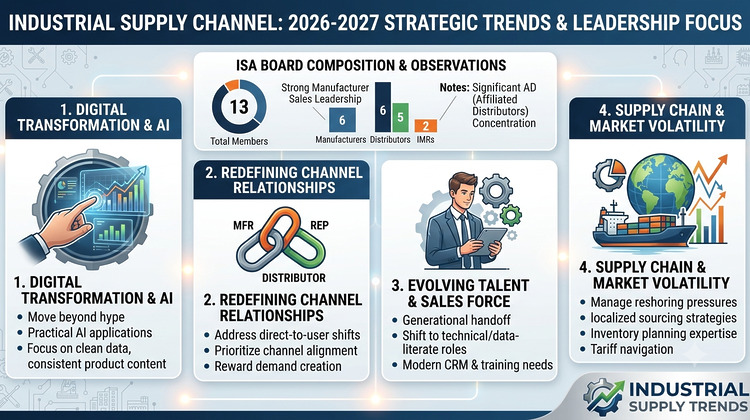
ISA recently announced their 2026 / 2027 Board of Directors to represent the membership and guide the leadership on the member’s needs. Further, with ISA having a small staff (by design), the Board of Directors also is the thought-leadership and idea generation segment of the association … it’s a think tank.
So, I decided to use AI for two of the things it is best at – research and correlating / interpreting information.
I asked our friend Claude to review the Board of Directors, research their background, and extract insights and correlations. Is it 100% correct, I’ll leave that to you, and the ISA membership, to decide.
Based upon Claude’s input, I’ve added some thoughts below (added with some intelligence, and some may think it’s “artificial but I can guarantee you that it is 100% me!)
Meet the ISA Board
ISA (the Industrial Supply Association) just named its 2026-2027 Board of Directors. A board isn’t just a list of names on a page — it’s a snapshot of where the power sits in a channel, who the membership trusts to set direction, and where the blind spots are likely to be. ISA’s new board is a strong one. It’s also a very AD-heavy one, and that’s worth understanding if you’re a distributor, manufacturer, or IMR trying to figure out where the association’s priorities will land over the next twelve months.
The Executive Committee
Brent Williams, President of US Tool Group, moves into the Chair role, with outgoing Chair Keith Mudge, VP of Sales – Americas at Kennametal, sliding into Immediate Past Chair. Patrick Baliva, VP of Sales at Saint-Gobain Abrasives, becomes Vice Chair. Jessica Yurgaitis, CEO of Industrial Supply Company, takes over as Treasurer, and Bill Davis, VP of Industrial Distribution Sales at Snap-on, becomes Secretary.
The board’s newest addition is Chuck Delph, CEO of Vallen, who joins as a Director — a notable get, given Vallen’s scale and its own recent history of marketing-group re-engagement (more on that below).
Segmenting the Board: Who Holds the Seats?
Breaking the thirteen-member board down by channel function tells you a lot about how ISA sees its own membership.
Manufacturers — the brand power. Six of the thirteen seats sit with manufacturers, anchoring the MROP (Maintenance, Repair, Operations, and Production) category. Their board members are almost uniformly channel-strategy and sales-leadership executives rather than product or operations people.
| Board Member | Title | Company | Segment |
| Keith Mudge (Immediate Past Chair) | VP of Sales – Americas | Kennametal | Metalworking & Cutting Tools |
| Patrick Baliva (Vice Chair) | VP of Sales | Saint-Gobain Abrasives | Abrasives & Surface Solutions |
| Bill Davis (Secretary) | VP, Industrial Distribution Sales | Snap-on | Hand & Power Tools |
| Paul Richardson | Sr. VP, Industrial & Commercial | Milwaukee Tool | Power Tools & Accessories |
| Sheila Schalk | VP of Sales | Protective Industrial Products | Safety & PPE |
| Teresa Wu | VP, Industrial Channel, USAC SIBG | 3M | Adhesives, Abrasives & Safety |
Distributors — the feet on the ground. Five seats span a billion-dollar public distributor down to family-owned regional players, a healthier mix than it might first appear.
| Board Member | Title | Company | Focus |
| Brent Williams (Chair) | President | US Tool Group | Tool Reconditioning & Integrated Supply |
| Jessica Yurgaitis (Treasurer) | CEO | Industrial Supply Company | Regional Independent Distribution |
| Chuck Delph | CEO | Vallen | Integrated Supply & Technical Safety Services |
| Sara Dulski | VP/GM, Metalworking | MSC Industrial Supply Co. | Specialist Verticals & Large-Scale MRO |
| Molly Langdon | SVP, Customer Experience | Stellar Industrial Supply | E-Commerce, Digital CX & SCM |
The Independent Reps: Territory Eyes and Ears
Two seats belong to IMRs: Patrick McKeever, President of Durrie Sales, and Harly Savage, Owner of Coast Industrial Sales. In a channel where reps are too often an afterthought in association governance, having two independent agency principals with a direct vote matters — they’re the ones who see both the manufacturer’s product push and the distributor’s local reality up close, every day.
Scale and Representation: The AD Concentration
Here’s the pattern that jumps out once you cross-reference company names against marketing-group membership: of the five distributor seats on this board, four sit with companies affiliated with AD (Affiliated Distributors). Brent Williams — the incoming Chair himself — leads US Tool Group. Jessica Yurgaitis, the incoming Treasurer, doesn’t just belong to AD; she chairs the board of AD’s Industrial, Safety, and Construction (ISC) Division, recently renamed from Industrial & Safety to reflect the group’s expansion into construction. Chuck Delph’s Vallen rejoined the independent-distributor community through AD back in 2022, and Molly Langdon’s Stellar Industrial Supply has been a long-standing AD member. Only Sara Dulski’s MSC Industrial Supply — a large, publicly traded distributor with no marketing-group affiliation — sits outside that circle.
That’s not a criticism of AD, which is by any measure the dominant buying group in this space. But it does mean other national marketing groups have no direct seat at the table, and it’s a dynamic ISA’s leadership should stay conscious of. An association board that leans this heavily toward one group’s ecosystem needs to make an active, visible effort to serve the entire independent channel — not just the AD-aligned portion of it — if it wants every member company to see itself represented.
What Should the Board Focus On? Beyond Purchasing
Marketing groups already handle procurement, rebates, and vendor programs — that’s not ISA’s job, and it shouldn’t try to compete there. Where an association board like this one adds real value is on the macro issues no single company or marketing group can tackle alone. Four areas stand out:
1. Bridging the digital hype gap. As we wrote in our recent ebook, The AI-Enabled Distributor, the technology is moving faster than most organizations’ ability to actually use it. With Molly Langdon’s customer-experience background on the board, ISA has the right voice to push members past the AI hype cycle toward the unglamorous work that actually pays off: clean product data, consistent content standards, and digital tools that remove friction from quoting and order processing rather than adding another dashboard nobody opens.
2. Redefining the manufacturer-rep-distributor relationship. Manufacturers keep looking for ways to get closer to the end user, and digital platforms keep making direct purchasing easier to execute. With two independent rep principals — McKeever and Savage — sitting on the board, ISA is well positioned to lead a real conversation about channel alignment: how do you reward the partner that actually creates demand, not just the one that happens to fulfill the order?
3. Talent and the evolving sales desk. The generational handoff happening in industrial sales right now is bigger than most companies want to admit. The relationship-only, drop-by sales model is being replaced by technical, data-literate advisors who expect modern CRM tools and real training infrastructure, not a three-ring binder. ISA’s education and workforce-development programs need to keep pace with that shift, not just formalize what’s always been done.
4. Supply chain reshoring and tariff volatility. Between tariff swings, reshoring pressure, and ongoing shipping disruption, distributors are re-forecasting more often than they’d like. With Chuck Delph bringing Vallen’s integrated-supply and services background to the table, and Sara Dulski’s category-management lens from MSC, the board has real operating expertise to draw on here — the opportunity is to turn that into practical guidance on inventory planning and localized sourcing that smaller members can actually use, not just another tariff-tracking webinar.
The Bottom Line
This is a capable board — strategic commercial leadership from the manufacturer side, real operating scale from distribution, and, refreshingly, an actual vote for the independent rep community. The job now is to make sure the board’s priorities serve the whole ISA membership, not just the large, AD-affiliated companies best represented in the room. If this group can help the sub-$50 million independent distributor move as fast digitally as the billion-dollar players, while keeping manufacturer and rep partners genuinely aligned rather than just co-located, the industrial channel comes out of this cycle stronger for it.
Observations on the ISA Board
- It is well balanced in the sense of manufacturers vs distributors vs reps although, as mentioned, the Board is weighted to large distributors with no representation of small to mid-sized distributors. Is this because leadership wanted larger companies who tend to be larger financial backers? Is this recognition of the consolidation trend and the small to mid-sized distributor’s voice is not that important anymore? Or perhaps no small to mid-sized distributor wanted to get involved feeling that it would not make a difference.
- The distributor weighing of AD is interesting. It says that ISA seeks to strengthen relationships with AD or is concerned that by not involving AD members then those members may drift further into the AD sphere and be less involved. No representation from NetPlus? Other marketing groups?
- Given the focus by manufacturers and distributors on AI, and that service provider revenue growth is occurring due to AI-powered companies joining the association in pursuit of introductions, perhaps rather than a sales, channel, and senior management role involvement, adding someone, or multiple (distributor and manufacturer) technophiles / digital transformation leaders would benefit ISA leadership and the association.
- Given that the Board tilts to senior management from large companies, this infers individuals who are “tenured.” Is there enough age diversity to encourage new leadership ideas?
Perhaps the real question isn’t whether ISA has assembled an impressive Board—it clearly has. The question is whether the Board, and association leadership, can look beyond its own interests / the interests of their companies, and focus on strengthening an industry that is becoming larger, more consolidated and more technologically sophisticated every year. If it can, ISA’s influence will grow. If it can’t, members will increasingly look elsewhere for education, networking and strategic insight.
And we know that marketing groups are offering more services, education, and networking than ever before.
The question becomes, “why do / should distributors belong to an association?” (and I had a distributor ask me this question two weeks ago, and they currently are not a member.)


Leave a Reply