
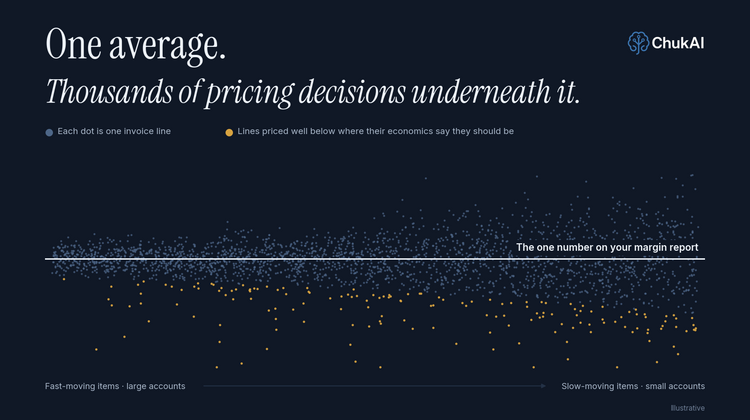
Most pricing programs deliver a first-year margin bump. The better question is what year three looks like.
By Jack Lyden and Chris Laham
In our experience, year three of a pricing initiative has little to do with the quality of the math. Margin gains fade when the people quoting prices every day stop believing what the system tells them, and management stops giving them reasons to. Pricing is a behavior problem dressed up as a math problem.
And margin isn’t the only thing that fades. A distributor can hold its percentage and still lose ground: order volumes slip, recurring customers drift, new opportunities go unseen. Pricing usually unlocks the first wave of profit improvement; it captures the low hanging fruit. Sustaining gross profit growth takes continuous intelligence across pricing, customers, markets, and commercial operations.
Ask what actually sets the price
Most distributors can tell you their margin by branch, brand, and rep. Far fewer can tell you what set the price on a given line: system guidance, a customer contract, a default rule, or a rep’s judgment.
ERP pricing logic works through an order of precedence, and after years of acquisitions, new customer types, and one-off fixes, that order drifts. We have seen large shares of revenue priced off a fallback rule nobody chose, outranking the guidance someone spent months building, with no one the wiser.
You can’t manage pricing behavior until you know which prices were ever a decision.
Treat overrides as feedback, not misconduct
When margin disappoints, the instinct is to look at the reps: tighter approvals, harder conversations.
Sometimes that’s right. More often, a rep overrides because the guidance is wrong often enough that they’ve stopped believing it. Broad product-group guidance prices like-for-like products the same for everyone, when the right price depends on the customer’s channel, size, and price sensitivity, and on the competition in that region. The rep knows the difference. The system doesn’t. The gap is widest in the long tail, where small accounts buying slow-moving parts care more about availability than a few points of price, and where broad guidance most often underprices.
So every override is information about where guidance has drifted from the market, as long as you capture why it happened. Reason codes, margin floors set by customer and product, and dashboards managers actually open turn overrides into a stream of corrections. In our work, override rates have fallen fastest when the guidance got better, not when the policing got stricter. Reps follow prices they believe.
Keep score in gross profit dollars
Once pricing is working, the next trap is to keep turning the dial, because margin percent goes up and looks good on a slide. But margin percent is a ratio, and ratios can improve while profit shrinks. Push price too far and volume walks, taking gross profit dollars with it.
Revenue growth can be equally misleading. Higher average invoice values can mask falling transaction volumes, customer attrition, or erosion in recurring business. Distributors need to understand the quality and composition of their revenue, not just price realization.
Recurring and project business behave differently. Recurring customers buy steadily, and that relationship is where share of wallet is won or lost. Project orders are larger and episodic; each costs more to serve, while recurring business costs more in aggregate. A blended number hides both. Stratify revenue by segment, territory, supplier, and product category, and you can see which customers are buying less and which projects pay their way.
The scoreboard that matters is gross profit dollars, and the best of them repeat. A recurring dollar of gross profit is worth far more than a one-off dollar to whoever owns the business, whether that’s a family, a sponsor, or a future buyer.
Make it a loop that management owns
Costs move, suppliers change programs, customers change how they buy. Guidance that was right in January is stale by fall. An initiative ages. A loop compounds.
The same line-level data that sharpens pricing shows management where revenue is trending, which relationships are deteriorating, and which growth opportunities deserve attention first. Add outside context (regional market size and estimated share, competitive position, end-market exposure) and a sales decline stops being one number. It becomes a diagnosis: a pricing problem, a shift in demand, a competitor taking share, or a gap in execution. Each calls for a different action.
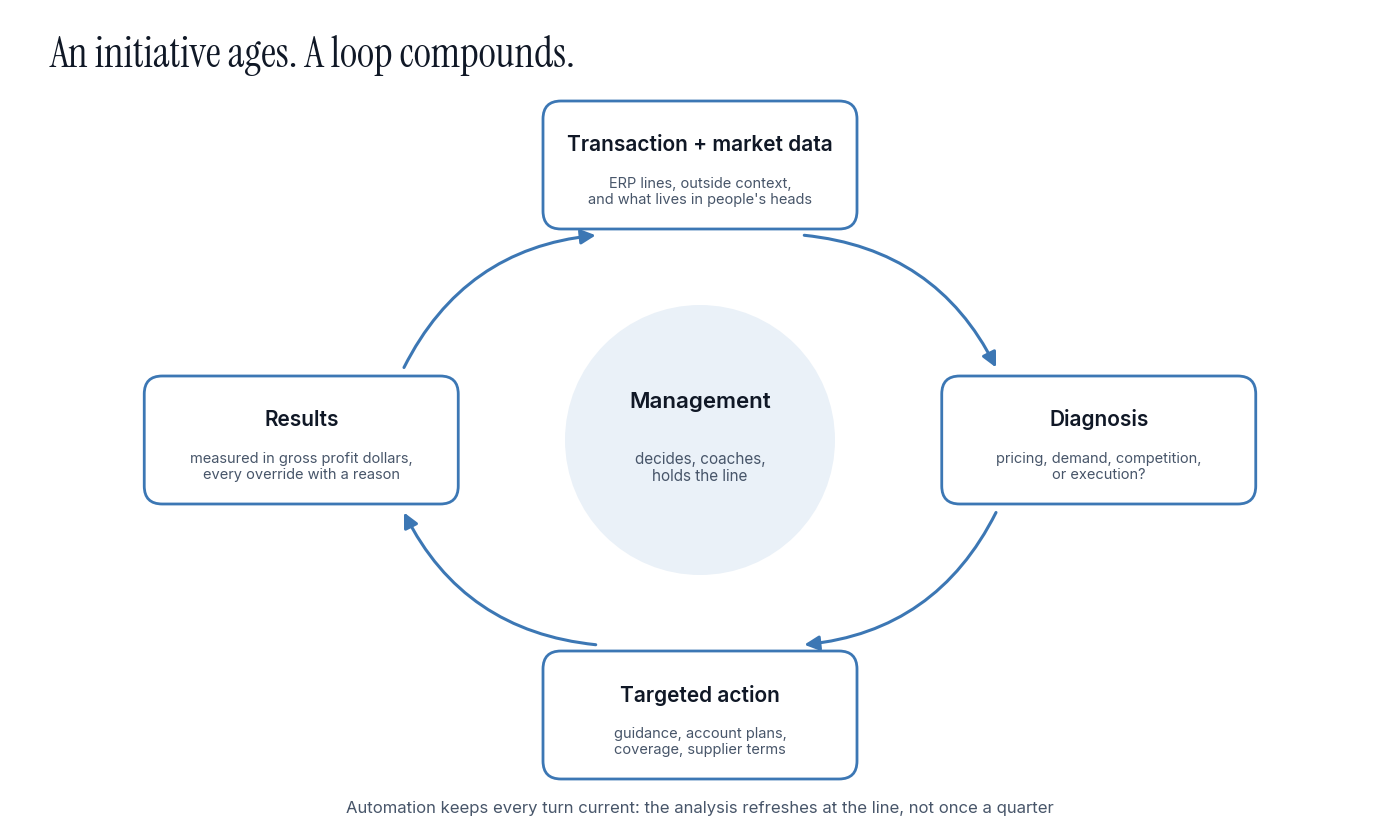
Analytics inform management’s decisions, the field acts on them, and the results, every override and its reason included, feed the next cycle. Two things keep it turning. The first is automation: the analysis refreshes continuously, at the line, without a team rebuilding spreadsheets every quarter. The second is management commitment: leaders who coach to the data, review results as a habit, and hold the line when a rep pushes back.
Some of the most valuable inputs aren’t in the ERP at all. They live with the people who have run the business for years, and getting them into the analysis is half the work.
The outcome is profitable growth, not better pricing software
Technology is the enabler, not the deliverable. It should do its heavy lifting where no one has to look at it.
For distributors, the objective is sustainable gross profit growth. For owners and PE sponsors, that translates into stronger earnings, commercial resilience, and greater enterprise value. The work can start before a sale or acquisition, sizing the profit opportunity, and continue after close as a repeatable value-creation program that shows up on the P&L in year three as much as year one.
| Jack Lyden and Chris Laham are the co-founders of ChukAI, an AI-native services firm that improves profitability for mid-market industrial distributors across engineered products: automation, motion control, fluid power, material handling, and robotics. Jack has advised private equity firms on more than 100 industrial manufacturers and distributors; Chris builds the data and machine-learning systems behind ChukAI’s work. See how a six-brand automation distributor cleared its full-year margin target by June or talk to us about your next wave of gross profit. |


Leave a Reply