
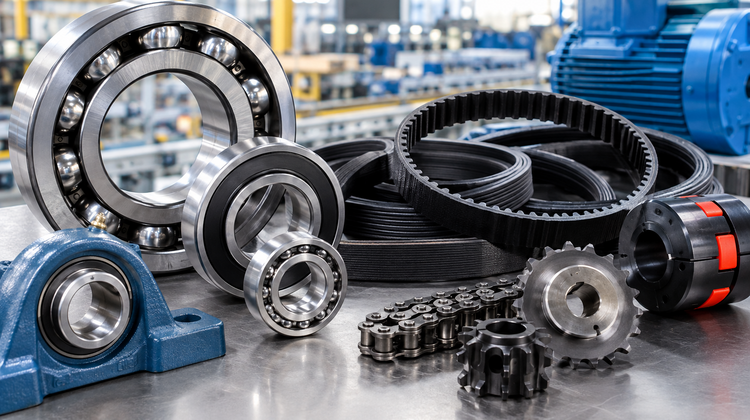
Manufacturers maintain proprietary part-numbering systems, while distributors map products to their own SKUs, creating inconsistencies across ERP and product-data systems.
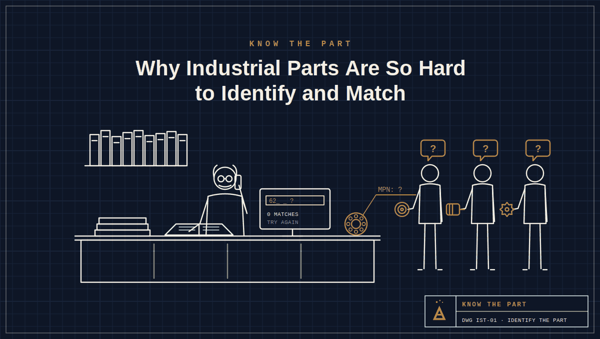
A part fails. The line is down, and every minute costs money. The replacement might be on a shelf ten miles away.
Before anyone can pull it, someone has to answer one question: what is this part?
We call it ‘Product Discovery’, and it’s the most difficult, least discussed step in the process of getting a replacement part.
The failed part rarely carries the orderable MPN (manufacturer part number) you need to pull it from stock or order it. The full model number is missing. What’s left is a partial string of the nomenclature, a basic number with no suffixes, or nothing at all because it wore off.
The full model number was on the manufacturer’s factory box. But that box went in the trash the day the part was installed.
So the part number your customer has on the failed part isn’t the one in your system, and it most likely doesn’t match the actual part number. That gap is where the product data problem starts, and it isn’t closing on its own.
Product discovery and part identification in industrial markets remain unnecessarily difficult, despite today’s technological capabilities.
The number rarely survives the part
There are many reasons the full number is missing…
- Space. A part can only carry so many characters, so manufacturers mark what fits, usually the base (or basic designation) number. The suffixes that decide seals, clearance, precision, lubrication, amperage, frame, and a massive list of specifications more often live only on the manufacturer’s box. A precision bearing can carry five characters on its ring while the number you’d order it by runs twenty plus characters as it could be alphanumeric … and have a hyphen!
- Shared base numbers. Manufacturers build their part numbers on a base number, then add prefixes and suffixes or other nomenclature for each version, so the part is only stamped or labeled with the designation number. One base number can sit under a whole family of orderable parts that differ in voltage, revisions, contact angle, etc… and even an entire product family like categories or types. When a part is marked with only the base number, it could be any one of them.
- Life. Heat, oil, grit, paint and cleaning take the rest. Motor nameplates and gearbox tags get painted over. Stamped numbers wear smooth. Electromechanical and automation parts take the same abuse: labels fade, peel or burn off. And part of life is age. The part may be multiple years old. It could have faded or been worn off, fully or partially.
- Relabeling. Many machines ship with the machine builder’s own part numbers on the parts list, not the manufacturer’s; sometimes called white or private labeling for the OEM. The maintenance record points to a number nobody else stocks.
- Time. Numbers get superseded, product lines get sold and brands get retired. The number on a 20-year-old part may not exist in any current catalog.
In Bearings, PT & Electromechanical, every manufacturer writes their own
Now multiply that across just one vertical; Bearings and Power Transmission. The Power Transmission Distributors Association puts the North American power transmission and motion control market, which includes bearings and motors, at $104 billion.
No one comes close to owning it. McKinsey found that the top industrial distributor in almost every U.S. segment represents less than 6 percent of the market. The fragmentation is wide, and if you ask any expert out there, they will openly tell you the reasons for why the industry hasn’t consolidated much are unknown.
Every manufacturer in this market writes their own part numbers, in their own internal structure. Many manufacturers produce identical parts, with completely different characters. It’s like a different language. The result is more part numbers than any one person could ever learn. It’s possible the range is in the hundreds-of-millions.
Nothing forces them to line up. Other industries had something that did. In 1952, Congress passed the Defense Cataloging and Standardization Act, and the law that grew out of it still requires that only one identification be used for each item across the Department of Defense, think aerospace parts. The auto aftermarket agreed on shared data standards through its trade association. It had something to hang a standard on: every part fits a known vehicle. Application software works in both industries.
Bearings, Power Transmission, Electromechanical and Industrials overall have had neither: no buyer big enough to force one number per part, and no association with the reach to get every manufacturer to agree on one.
Industrial has no equivalent to the National Stock Number and lacks a centralized application system.
Then distributors re-key it
Many distributors build their own item master, with its own numbers (often referred to as ERP, or internal numbers), abbreviations and description rules, squeezed into whatever fields the system allows.
Over the years, the same part ends up under several SKUs, resulting in duplicates. Descriptions drift. The suffix that mattered gets cut to fit. That’s how SKUs get messy in your ERP, and messy data doesn’t search well. Garbage in garbage out is overused, but accurate. If you want a thrill, try ordering an industrial part from the largest marketplace using data alone.
Type a partial number into that system and it looks for what you typed, not what you meant.
Data cleanup software helps, but it can only work with the numbers it’s given. When the source numbers are partial, it’s still a guess, which is why it takes an expert.
The distributor is the translator
This is where distributors earn their place. Product discovery is a core part of the job: the experts take a worn part, a partial number or a description over email, and turn it into something orderable.
It typically takes a lot of back and forth communication, but the part gets identified and the end user gets their line back in operation.
In most of the segments, that skill doesn’t live in a software system. It lives in a person’s memory and product knowledge. All branches have at least one: the veteran with 40 years in the trade who can look at a worn part, ask a few questions and tell you what it is, who else makes it, which suffix matters and what interchanges can be used.
They know the nomenclature, the supersessions and the look-alikes along with the cross-sells (the parts that go with it.) Almost none of it is written down. That’s industry-expert tribal-knowledge, and for decades it has worked well.
Most of it is learned the same way it was taught: at the counter, one part at a time. There’s no manual for reading a worn nameplate, and it can take years to get fast at it.
The Silver Tsunami
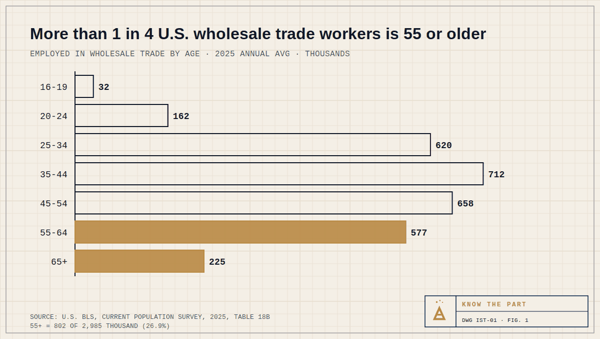
But that tribal knowledge consistently exits the door every year. More than one in four people employed in U.S. wholesale trade in 2025 were 55 or older.
The same thing is happening on the plant floor. Deloitte and the Manufacturing Institute project that manufacturers could need as many as 3.8 million new employees between 2024 and 2033, and that 1.9 million of those jobs could go unfilled.
The people who can identify parts are leaving exponentially. The people replacing them inherit the problem without the memory.
And the industry has never been an easy sell to younger workers, the local branch is rarely anyone’s first choice of career.
A new hire doesn’t just gain enough knowledge to start identifying parts, it takes decades.
Where that leaves the industry
In the highly-fragmented industrial world, with thousands of distributors, manufacturers, and enormous SKU counts, no single company holds the full map from a worn part to the right part number. Even the best search engines and LLMs get it wrong.
Model numbers on failed parts are often incomplete, maybe even from day one. Every manufacturer writes its own numbers, and distributors re-key them into their own system. The knowledge that connects them sits mostly in the heads of people nearing retirement.
That’s why identifying the part, before anyone can quote, pull or even order it, remains the hardest step in the sale. It’s also the step least supported by data.

Brandon Kelley is co-founder and CEO of Araday, the product knowledge platform for industrial products, building product discovery, cross-referencing and cross-selling tools for bearings, power transmission and electromechanical parts. Connect with him on LinkedIn and follow Araday.
Suggest Tags: Product Data, Product Discovery, Bearings, Power Transmission, Electromechanical


Leave a Reply