
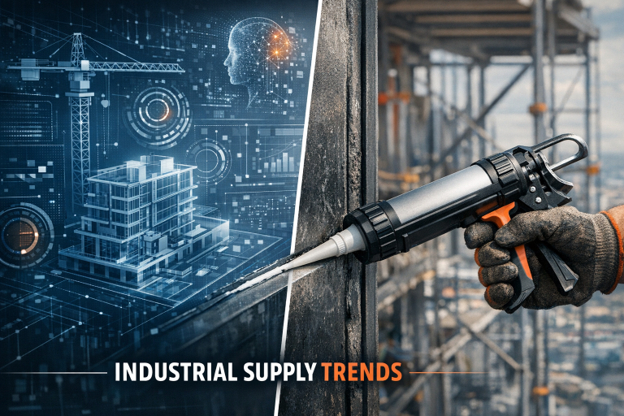
eCommerce. AI. Direct connectivity between customers and distributors. Access to manufacturer portals. The construction and industrial distribution channels are no longer only about product knowledge, logistics, access to credit (for customers) and personal relationships. You need to not only be able to use technology but sometimes you feel like you need to be a technology maven.
Lizzy Higgins from Newborn Caulk Guns agrees that tech is needed but suggests that sometimes we become so obsessed that we miss the little things … like what goes into customers’ hands.
And when you think about it, a customer’s installation tools are to the lifeblood of their vocation. Think about how loyal customers are to certain hand tool and power tool brands.
When Lizzy shared the below article, which is very interesting and informative, I said “caulk guns?” And she shared that it is about a $250M market.
Okay, yes, it is small. From a marketing viewpoint I consider this a micro-niche. But if you don’t have it for the customer … it’s a lost sale.
Moreso, I spoke at a contractor conference last week about improving project profitability. While procurement labor savings help improve project profitability, so does onsite labor savings. And this is where Lizzy shares distributors can add value by suggesting “the right caulk gun.”
Take a read and ask, “what is in your hands.”
The Construction Industry is Obsessed with Digital Tools, but it’s Time to Pay Attention to the Ones in Contractors Hands.
AI gets the headlines. But the real opportunity for distributors and manufacturers in 2026 might be the unglamorous tool sitting in every contractor’s truck.
Every conversation about the future of the construction industry follows the same predictable script, including the all-important AI buzzwords. We are told that the future of the industry is digital – which, long term, is probably true. But I challenge anyone who says this to look at the actual contractors, on actual jobsites, doing the actual work, who still depend on hand tools every single day. You remember those, right? You know, screwdrivers, caulking guns, hammers, drills? If you walk onto a commercial waterproofing job in downtown Charlotte today, you won’t see a robot. You’ll see a crew of four people on a scaffold, eighteen stories up, physically squeezing triggers to dispense high-viscosity sealants.
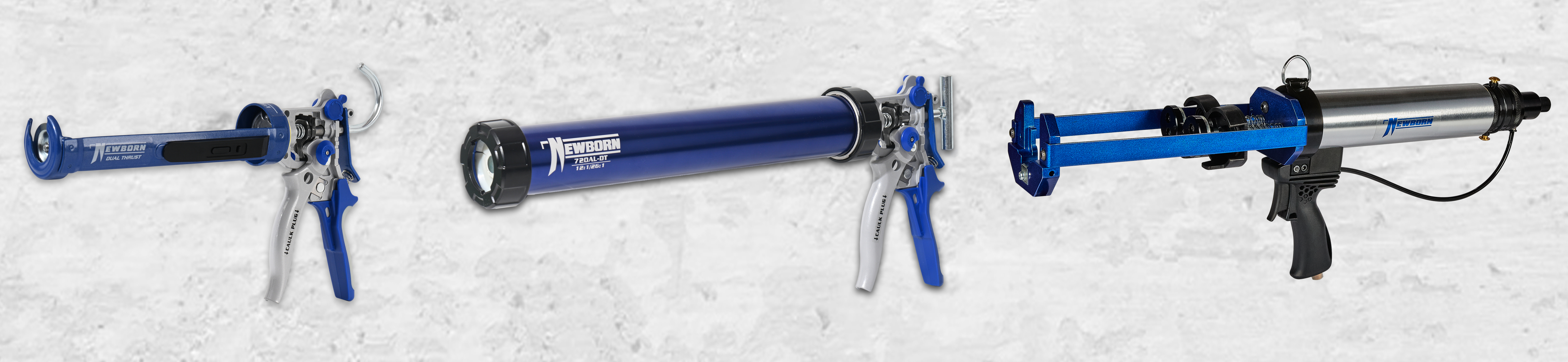
We can’t use the presence of physical products to discount the ever-present, ever-advancing digital age, but more importantly, we cannot let physical tools get lost in the shuffle; left behind with limited innovation, impacting construction crews across the world. If we always chase the ‘next big thing’ in software, we are ignoring the mechanical innovation of the ‘small’ but incredibly important things – the tools that allow contractors to get the job done. In one corner of that gap sits a category most reps would never put on a top-ten list: the humble caulking gun.
Here’s the case for taking it seriously.
The Category Is Bigger Than You Think
Industry analysts pegged the global caulking gun market at roughly $2.6 billion in 2024, with forecasts pushing it toward $3.9 billion by 2032. The U.S. alone accounts for an estimated $250 million annually and is growing at a steady 4% clip. It is not a glamour category, but it is not a rounding error either.
More importantly, it is a high-frequency consumable-adjacent purchase. A commercial sealant or waterproofing contractor does not buy one caulking gun every five years. Crews lose them, beat them up, upgrade them when a foreman finally gets fed up, and replace them in batches when a new bid lands. For a distributor, that is the exact kind of product profile that drives repeat orders and basket attachment, since a caulking gun rarely walks out the door alone. It walks out with cartridges, tips, mixing nozzles, gloves, and rags.
And in 2026, the labor math is making the category more strategic, not less. The Associated Builders and Contractors estimate the industry needs roughly 349,000 net new workers this year just to keep pace with demand. Every contractor in America is being asked to do more with fewer hands. A better hand tool is no longer a ‘nice to have’ line item. It is a productivity intervention.
Why the Category Is Hard to Sell (and Why That’s the Opportunity)
Let’s be honest about the problem. Caulking guns are not exciting to stock and not easy to sell. They look the same on the shelf. The price ladder from a $5 hardware-store gun to a $50 high-thrust professional model is invisible to the casual buyer. Sales reps would rather talk about anything else, and contractors often default to whatever they grabbed last time, even when it’s costing them hours of labor per week.
That is the opportunity. A category where the end user is under-educated and the rep is under-confident is a category where the manufacturer that invests in enablement wins outsized share. The math is straightforward: if a distributor’s sales team can articulate the difference between a 12:1 and a 26:1 thrust ratio in one sentence a contractor actually cares about, conversion goes up. If they can’t, the contractor buys on price and everyone loses margin.
What Actually Makes a Caulking Gun Worth Selling Up
The professional sealant and waterproofing trades care about three things, in roughly this order: thrust ratio, dripless performance, and durability. Translate that for a distributor’s sales floor and it sounds like this.
Thrust ratio is labor. A 26:1 gun moves high-viscosity polyurethane with a fraction of the trigger force of a 10:1. On a multi-day waterproofing job, that is the difference between a crew finishing on schedule and a crew finishing with a Popeye arm. Contractors will pay a premium for a tool that removes a real source of fatigue from their day. They have to be told, clearly, that the premium is there for a reason. Different thrust ratios are needed for different materials and having the correct thrust gun makes a world of difference. A dual thrust gun that can do both? Well, that’s a game changer.
Dripless is material. Sealant is expensive. A gun that stops cleanly at the end of a bead saves cartridge waste and saves clean-up time. That is a cost-per-job argument any contractor estimator understands instantly.
Durability is total cost of ownership. A $100 professional gun that lasts three years is cheaper than three $60 guns that last a year each, and a sealant contractor on a commercial scope already thinks in those terms. The job of the rep is to make that math visible at the point of sale.
None of these arguments are new. What is new is how few sales teams are actually trained to make them.
How to Actually Sell It: Five Tactics That Move the Needle
1. Demo, do not describe. This is a tool you have to feel. The single highest-converting moment in the category is a contractor squeezing a high-thrust gun loaded with cold polyurethane next to the gun they currently own. Manufacturers should be making demo kits cheap and easy for distributor counters and outside reps. Distributors that build a counter-day program around hands-on demos consistently outperform those running spec sheets.
2. Stocking incentives with a real time horizon. A short-window stocking program tied to a product launch, with a coupon code the rep can actually hand out, gives distributor branches a reason to make space on the shelf. The mistake most manufacturers make is launching with no urgency and then wondering why nobody reorders. Set a window. Make the math obvious. Honor it.
3. Sell to the trade association, not just the contractor. In the sealant and waterproofing world, the Sealant, Waterproofing & Restoration Institute (SWRI) does more to shape contractor purchasing behavior than any single ad campaign could. Manufacturers that show up consistently in trade publications, contribute technical content, and sponsor association events get pulled through by spec, not pushed through by promotion. Distributors should be asking every vendor what their association strategy actually looks like.
4. Ride-alongs are still the best sales training there is. A manufacturer rep on a truck with a distributor’s outside salesperson, calling on a commercial waterproofer, will close more business in one day than a dozen webinars. This is unglamorous and expensive, but it works. Distributors should be demanding it as part of their vendor relationships.
5. Online is real, even for B2B. Contractors search. Crew foremen watch product videos on their phones during lunch. Amazon listings, YouTube demos, and even short-form social content drive specification long before a rep ever walks in the door. A manufacturer that ignores that pipeline is leaving qualified demand on the table, and a distributor partnering with one that does invest there benefits from the pull.
Creative Marketing in an Unsexy Category
The most interesting marketing happening in the caulking gun category right now is not happening in trade ads. It is happening in three places.
Contractor-generated content. Crews already film themselves running beads on Instagram and TikTok. Manufacturers that build small ambassador programs around real applicators, rather than polished agency talent, get authentic content for a fraction of the cost of traditional production. The footage is better, the trust is higher, and the contractor audience can spot a fake from a mile away.
Trade publication thought leadership. A column or technical contribution in the magazine a contractor actually reads carries more weight than a paid ad next to it. Manufacturers playing the long game contribute regularly. Distributors should be steering their best vendors toward this kind of placement and amplifying it through their own channels.
Coordinated paid and earned launches. A new product launch that hits paid social, trade press, distributor stocking incentives, and contractor influencer content in the same window outperforms any one of those channels in isolation. The integration is the strategy. One mid-size manufacturer in this category is currently running an eight-initiative launch plan against a single product family. That kind of coordination is rare in industrial supply, and that’s exactly why it works.
Where AI Actually Fits
Back to the AI conversation, because it does belong here, just not where most pundits put it.
Caulking robots are not coming to save the labor crisis any time soon. What is happening, quietly, is that small and mid-size hand-tool manufacturers are using AI to compress the work of go-to-market. Drafting sales enablement materials, building distributor training decks, generating product launch campaign assets, analyzing sell-through data across accounts, all of it now takes a fraction of the time it used to. That means faster launches, more polished collateral landing on distributor counters, and frankly, more competitive pressure on the manufacturers that have not figured this out yet.
For distributors, the practical implication is simple: the manufacturers that are using AI well are going to show up to your branch reviews with sharper data, better training content, and faster turnaround on co-op marketing requests. The ones that are not, won’t. That is a useful filter to start applying now.
The Bottom Line for Distributors and Manufacturers
The construction industry needs to broaden its definition of innovation. A solution does not have to be AI-enabled to be brilliant. A better caulking gun, sold through a trained rep, demoed at a counter day, backed by association credibility and contractor-generated content, can move millions of dollars of sealant and waterproofing material through a distributor’s network. That is not a hypothetical. That is what’s happening right now in branches that have leaned into the category.
The industry is currently over-invested in software that tells us why we are behind schedule, and under-invested in the hardware that could actually help us catch up. The distributors and manufacturers paying attention to that gap are the ones who will own the next five years of this category.
The tools in the truck are still where the money gets made.
Lizzy Higgins is the National Sales & Marketing Director at Newborn Brothers Co., a manufacturer of professional caulking guns headquartered in Hanover, MD.


Leave a Reply