

Industrial buyers have been in the midst of change, much of it precipitated since Covid. Generational change in the workplace; utilizing digital tools to buy and manage projects; channel fragmentation. Manufacturers, seemingly always seeking to “meet the quarter” have adapted with website upgrades, product content attribution development, personnel changes, online training programs for the channel and yes, seeking additional channel relationships to meet customers where and how they want to buy.
And one of the channels that they knew about but barely addressed is Amazon Business.
Amazon Business, started as Amazon Supply over 10 years ago, is emerging more and more as a channel. While nascent for many and seemingly dismissed as a consumer-site or solely for long-tail items, is gaining traction. For some it’s a search engine, for others a viable procurement channel.
Enceiba, a leader in helping B2B companies navigate Amazon Business, is an ISA member and share their observations.
Amazon Business as an Industrial Supply Channel
Over the past couple of years or so, we’ve seen a shift in thinking among B2B manufacturers. While in the past manufacturers would often say, “We sell through distribution only,” At Enceiba, we’re hearing more and more businesses warm up to the idea of selling through Amazon.
Despite the apparent growing interest in Amazon, many industrial supply manufacturers remain wary. Their caution is somewhat justified, particularly when they get angry calls from distributors about unauthorized resellers on Amazon. In fact, channel conflict is often the most cited reason manufacturers steer clear of selling on one of the world’s largest marketplaces.
But that single reason for not selling on Amazon largely ignores a number of reasons why industrial supply manufacturers should, in fact, have a strong Amazon presence. Particularly on Amazon Business, the part of Amazon specifically designed for B2B sales.
Let’s take a closer look at the four reasons why every industrial supply manufacturer needs Amazon Business.
What Is Amazon Business?
Before we go into the reasons why B2B manufacturers should be selling on Amazon Business, it’s important to understand what it is and how it differs from the B2C side of Amazon.
As mentioned, Amazon Business is exclusively for B2B buyers. They need to register with a company email and business documentation (such as corporate tax ID number), among other things, to get access to a variety of business-specific features. These include:
- Business-only products and pricing, including tiered and bulk pricing for high-quantity purchases
- Multi-user accounts and approval workflows, allowing businesses to set up employees with access to the company’s Amazon Business account
- Integration with procurement systems
- Spend management tools and analytics
- Seller certifications and compliance filters
So, why should B2B manufacturers be paying attention to this?
1. Amazon Business Is Huge—And Getting Bigger
There should be no doubt that Amazon is one of the largest Ecommerce sites in the world, with more than 300 million users spending over $630 billion in 2024. Amazon’s success in B2C has bled over into its B2B side, counting more than 8 million active customers globally, including 96 of the Fortune 100 companies and 90 out of the top 100 most populous local governments in the U.S. Launched in 2015, Amazon Business has rapidly grown, reaching an estimated $67 billion in annualized sales in 2024 and a projected explosion to $83 billion in 2026.
Amazon Business has become the first place many B2B buyers go when making purchases, with 60 percent of business buyers making one out of every four purchases there and nearly 30 percent of buyers making more than half their purchases on the site.
2. Amazon Business Gives B2B Manufacturers More Control versus other Selling Approaches
One of the top complaints that B2B manufacturers have regarding selling on Amazon is how their products are presented. Too often, unauthorized, opportunistic resellers use poor product images and inaccurate information to populate product listing pages. Additionally, these sellers often compete only on price, driving prices down in order to capture more sales. B2B firms frequently don’t even know how those resellers came to be selling their products in the first place!
Amazon Business, particularly when paired with the 3P Seller Central selling approach, gives B2B manufacturers significant control over how their brand and products are displayed by using Amazon’s A+ Content tools. Firms can choose which images to show, upload product and brand videos, share spec sheets and technical details, and create branded storefronts. What’s more, B2B manufacturers can fully control their pricing and use Amazon Brand Registry to help them consolidate or remove unauthorized product listings.
Lastly, Amazon provides B2B sellers with tools to enable them to restrict visibility of products to certain audiences. For example, healthcare product manufacturers may want to restrict who can see and purchase their products to licensed medical professionals, as these are the only legally authorized buyers of their products in the U.S. This is particularly useful to any manufacturers who make and sell regulated products.
NOTE: Many of these features and services require B2B manufacturers to use the Seller Central model. Check out this article we wrote on the differences between Seller Central (3) and Vendor Central (1P) models.
3. Access to Data-driven Insights and Analytics
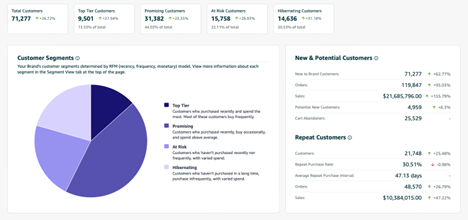
One of the biggest advantages Amazon Business offers to sellers is access to data-driven insights that typically go beyond the basic sales metrics that most manufacturers receive from their traditional distribution and retail partners.
Sellers specifically using the 3P selling approach can understand where products are being shipped and individual product demand signals, which can prove valuable in future business decisions. Additionally, Amazon Business equips its sellers with a suite of features tailored for B2B sales. These include bulk pricing automation, tax-exempt management, and B2B advertising tools to fine-tune campaigns based on real-time data.
4. Higher Conversion, Better ROI, More Incremental Revenue
Ultimately, the most important factor in deciding if Amazon Business is right for your company is whether you can actually sell more products there. And the simple answer is: Yes!
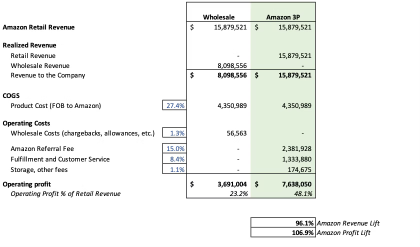
In fact, not only can you sell more, you’ll likely see higher ROI from Amazon vs. other channels due to higher potential profitability on Amazon, as well as incremental revenue.
While no official benchmarks for conversion rates or ROI on Amazon have been published, Enceiba’s hands-on experiences developing our clients’ Amazon presences tells us that B2B sellers typically see 10 – 15 percent conversion rates, or higher. This is significantly higher than standard Ecommerce conversions, which are generally about 2.5 – 3 percent.
Selling on Amazon, particularly through Seller Central (3P), yields significantly higher ROI and can boost revenues by 20 percent. Why? Because 3P sellers set their own retail pricing, which means they can decide what they profit margin is.
Want to talk Amazon Business and how you can grow on Amazon without channel conflict? Enceiba will be at ISA26! Reach out and schedule a time to chat with us here: https://8171650.hs-sites.com/isa-2026-meet-with-enceiba
Thoughts
- The above was shared by Enceiba, as they are an ISA service provider. According to their website “Enceiba is the only agency in the market focused exclusively on B2B.”
- While many may think of ISA as an association focused on the “industrial supply channel” and instinctively define this as “brick and mortar”, the reality is that Amazon Business is part of the industrial supply channel and helps distribute product through connections (the marketplace model) and when using them as a 3PL, they are a distributor, just with different services (reach, marketing, and fulfillment.) While they may not have the same product / application technical resources, there are many distributors who, honestly, don’t either or customers who do not need / value that type of service.
- As evidenced by Grainger, Fastenal, MSC and Global Industrial’s earnings reports, many industrial end-users are purchasing electronically. Much through punch-outs / direct connections but some through Amazon Business (especially some key product categories). Amazon Business is also used for long-tail orders.
- From a manufacturer viewpoint, it is important to understand this channel, understand the customers that buy from it, and how you could / should participate. In fact, Channel Marketing Group has done some end-user eCommerce research and has validated that small companies and incidental buying is occurring through alternate distribution channels.
- While the article is written targeting manufacturers, there is no reason why enterprising distributors should not take advantage of the same opportunity. You may not put on “every” SKU, especially once you consider margins and fulfillment costs, but there could be some. Or perhaps you become the eCommerce channel to this segment for a manufacturer who cannot / does not want to handle fulfillment … and maybe they will provide a SPA? Or perhaps you source some items and have high margins.
Amazon Business can be a channel for manufacturers and distributors.
Touch base with them at ISA ’26, or connect after the show.
And, if you are thinking about your business longer-term, what % of your business should be 1) conducted electronically (from a service / fulfillment / logistics viewpoint) and 2) what % of the business should be an electronic channel … originates on a website and comes into a warehouse?


Leave a Reply