

3M, a multinational conglomerate in the industrial, safety, and consumer goods segments, announced 2Q 2026 earnings on July 21, 2026. Revenue was $6.5 billion, an organic growth rate of 5.4%, driven by broad industrial strength, surging demand in semiconductors and data centers, strong execution and innovation, and a major rebound in China, with Safety & Industrial leading the company at 8.2% organic growth. This was offset by weakness in Consumer, down 2.1%, with management pointing to softer U.S. consumer spending and inventory adjustments at key retailers. Transportation & Electronics grew ~6%, driven by strong semiconductor and data‑center demand and backlog conversion, that more than offset automotive weakness.
For industrial distributors, the takeaway is that safety, abrasives, adhesives, electrical consumables, and electronics-linked categories remain healthy enough to support volume growth, but the winners are likely to be suppliers and channel partners that can pair pricing discipline with productivity gains.
Operating margin of 24.9%, increasing 40 basis points, driven by productivity gains, cost discipline, manufacturing efficiency improvements, and strong mix in high‑margin industrial and tech markets.
CEO Bill Brown highlighted the accelerated pace of innovation, with 92 new products launched in the quarter, up 44% y-o-y. This supports higher-value sales and margin mix.
However, 3M still faced headwinds despite strong underlying industrial and technology-market performance. These included non-operational profitability pressure from litigation costs, PFAS-exit costs, divestiture losses, ongoing restructuring and operational transformation costs, continued automotive weakness, and softness in certain consumer-facing categories.
We will focus on the Safety & Industrial Business Group (approximately 40% of total sales), where the majority of safety and industrial products that industrial supply distributors stock are manufactured. Key products include industrial adhesives and tapes, abrasives (e.g., Scotch-Brite), Personal protective equipment (PPE), filtration products and supply chain and inventory solutions (Onsite, Fastenal Managed Inventory equivalent).
The Safety & Industrial segment was the strongest‑performing 3M business segment in the quarter, delivering 8.2% organic growth — the highest of any segment. Growth was driven by broad industrial demand, strength in electrical markets, adhesives and abrasive and industrial electrical consumables, manufacturing productivity gains, and record throughput at key facilities (e.g., New Ulm, which delivered record output, adding $13M incremental revenue and added ~50 bps to Safety & Industrial growth).
3M has not formally announced any additional spin‑offs beyond the completed Solventum (healthcare) separation, but management has repeatedly signaled that portfolio pruning is ongoing. The most likely future divestiture or spin‑off candidates are small, non‑core, lower‑margin businesses inside Consumer low margin/slow growth office supplies, home improvement accessories), Transportation & Electronics (film and electronics components), and certain legacy industrial sub‑units.
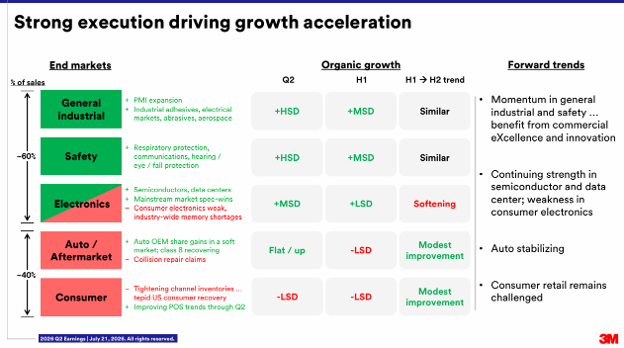
This quarters story centered around improved execution, pricing discipline, and operational efficiency, as core markets improved, and the outlook as shown below, remains positive – growth in industrial, safety, and electronics with slower consumer and auto end markets.
Analyst Concerns
Investors were focused on three recurring issues: whether industrial momentum can continue, how long consumer weakness will persist, and how much tariff/stranded-cost pressure will remain. The biggest implied concern is whether 3M can sustain high margins while still funding innovation, resolving legacy cost drag, and navigating a still-soft consumer channel – impressed with the execution, yes, but concerned about sustainability.
CFO Anurag Maheshwari stated that tariff impacts and stranded costs together reduced operating profit by about $110 million in the quarter. For the full year, 3M has guided to a $150–$175 million tariff impact and noted that no tariff refunds have been received to date, underscoring that this is a real, ongoing cash and margin drag.
Investors noted two scenarios:
- Tariffs and stranded costs persist at current levels, in which case 3M must keep delivering productivity and mix improvement to stay on track.
- Tariffs escalate or expand, which would require additional pricing, sourcing shifts, or cost actions to defend margins.
3M’s Outlook
Management raised full-year guidance after the quarter. The updated 2026 outlook calls for organic growth above 3.5%. That is a meaningful signal that management sees the second-half setup as constructive, despite the mixed macro environment and continued margin noise from tariffs and restructuring-related costs. The tone from the company was that the industrial side of the business is performing well enough to offset consumer weakness, and that productivity is helping keep margins resilient.
The main challenges for 3M in the rest of 2026 are clear: continued consumer weakness, tariff and stranded-cost drag, and capacity constraints in some facilities. Even with raised guidance, the company still has to prove that its margin strength can persist if industrial growth slows (due to inflation?) or if consumer demand remains uneven. For the broader manufacturing sector, 3M’s quarter suggests a cautious but real recovery: not a boom, but enough momentum for best-in-class operators to keep growing and pulling ahead.
What 3M’s Results Tell Us About the Overall Market
Industrial demand is still healthy enough to support mid-single-digit organic growth for a major supplier, especially in safety, industrial, and electronics-linked categories. The primary challenge is that the consumer side remains more fragile, which matters for MRO because end-market health is increasingly uneven rather than broad-based. Finally, pricing, productivity, and mix still matter a lot: 3M’s results suggest that the companies winning in 2026 are those with strong execution, new-product flow, and enough industrial exposure to offset softness elsewhere.


Leave a Reply