
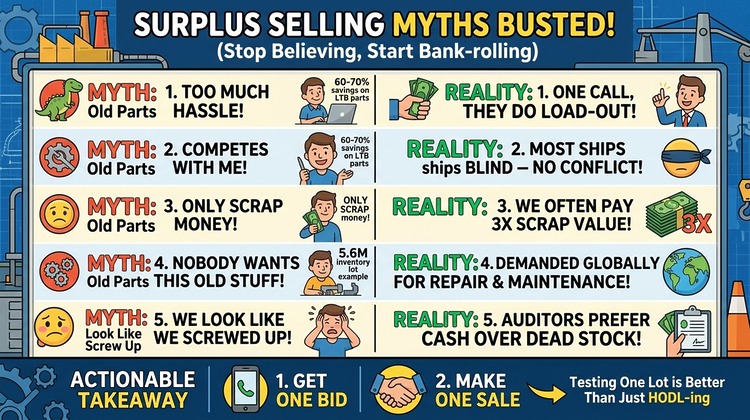
Myths of selling to a surplus house
All of them keep the profitable check on someone else’s desk instead of yours.
Every distributor and industrial plant is sitting on a bloated storeroom or warehouse full of parts, most have already talked themselves out of selling it.
Usually for years.
The reasons sound reasonable, in your head anyways. That’s exactly what makes them myths instead of excuses.
Most simply haven’t even contacted a surplus buyer yet.
Now it’s your call to make… after we bust some myths.
Lies You Tell Yourself Before You Ever Call a Surplus Buyer –
“It’s Not Worth the Hassle.”
This is the one we hear most, and it’s rarely about the money.
It’s the process people are picturing: build a stock list, send it over, then watch a buyer cherry-pick the good SKUs and hand the rest back for you to deal with.
“Just scrap it” is where a lot of sellers land instead. Not because scrapping pays better — because it’s one phone call.
A quality buyer doesn’t work that way. Either they take the entire lot, or they don’t take the call.
One of our purchases was a $280M automation OEM out of Michigan, clearing 2,580 sq ft section of their floor. We worked directly with their inventory manager, scheduled the load-out crew who packed the crates and loaded the trucks, ran three full truckloads on their timeline, and wired the funds the day they wanted it.
This company did not know us, they were referred to by someone else we work with however. I got the call on a monday, they were looking for a buyer, I flew out on thursday, shook hands with the president and the director of inventory and had them an offer by Friday. The money was in their account the next business day.
They had no accurate list. They didn’t want to go through the $5.6M in inventory they had to clear. So, meeting them in person at their warehouse and laying eyes on the dead stock was the least friction method to make a relationship.
They didn’t run a liquidation. They watched us run one.
The hassle was never the sale. It’s assuming you’re the one who has to do the work.
“They’ll Turn Around and Compete With Me.”
Said plainly, this is the fear: sell to us, and we’ll turn around and cut your own customers a deal to steal the sale.
A real buyer doesn’t do this. Most of what moves through a reputable surplus house ships blind — no distributor name on the box, no story about where it came from.
There’s no discount war to start with a customer who never learns the part passed through your warehouse in the first place.
No one wants a race to the bottom.
“We’ll Get Scrap Money For It.”

Run any of this by your finance manager and wait for the head nod.
Wrong meter. Scrap prices you by weight. A surplus sale prices you by what the part still does.
We typically pay triple + scrap value for a lot — same parts, same day, three times the check.
Call your scrap hauler and get his number.
Then get a surplus buyer’s number. The distance between them is usually the whole argument.
“Nobody Wants Parts This Old.”
Wrong buyer in your head. You’re picturing your own customer list. The real buyer is running the exact machine your part was built for, and the manufacturer or distributor just told them no.
These legacy parts usually sell far outside of your territory, often across an ocean.
Parts bought during a last-time-buy window can cost 60 to 70% less than the same component sourced three years after discontinuation. Read that backwards: the part gets harder and more expensive to find as it ages, not less valuable.
That’s not appreciation you get to bank by waiting. It’s demand from a buyer who needs the part now — not from you, later, after another few years of you paying for the privilege to HODL that part.
Your “obsolete” bin isn’t dead weight to everyone. It’s the only bin left for whoever’s plant is still running that line.
“Selling It Makes Us Look Like We Screwed Up.”
Now, someone did make a mistake. That finger should never be pointed.
And it’s the wrong order of events anyways. The write-down already happened.
If your books are honest, that inventory is already marked down to what it’s actually worth, sale or no sale — GAAP requires it.
That loss is sitting there right now, unsold, earning nothing.
Selling it doesn’t create the hit. It’s the only move that turns an already-recognized loss into cash. It’s the best move you have for any parts that have not moved in 12 months.
Most of this fear isn’t really about optics. It’s about admitting nobody’s double-checked those numbers in years. Again, nobody is straightening their finger and extending towards you.
An auditor doesn’t flag the distributor who converts dead SKUs into a wire transfer. They flag the one still carrying five-year-old stock at full value like nothing happened.
“Surplus Buyers Are a Back-Alley Channel, Not a Real Relationship.”
Some are. Most legitimate ones aren’t hard to spot.
For a large lot or first transaction, a serious buyer will get on a plane to see the lot before they quote it.
They will shake hands with you, break bread and talk shop.
Small lots can be priced via spreadsheet, photos can help.
Inventory owners have the right to ask how the buyers came to the bid price. Most do not ask. That happens more than people expect.
If an offer can’t survive you asking where the number came from, that’s the shady part — not the industry.
The Check Was Always Real
Every one of these myths does the same job. It keeps the shelf full and the phone unrung.
None of them are foolish. They’re just wrong often enough that believing them costs more than testing them would.
Price one lot. Get an actual offer before you decide the number isn’t worth chasing.
The operators clearing space this quarter didn’t find a loophole. They just stopped negotiating with themselves.
Brandon Kelley is an entrepreneur in industrials. His surplus company has purchased more than $600M in inventory, has been to hundreds of DCs, and helps distributors, manufacturers and OEMs recover the highest prices on surplus, inactive and dead stock, while remaining the least competitive. If you are looking for a reference, contact sales@central-surplus.com


Leave a Reply