

The Parts Nobody Wants to Hold — and Why You Need Someone Who Will
Surplus houses exist because the industrial supply chain produces inventory nobody can afford to keep — and everybody eventually needs.
Every Shelf Charges Rent
Holding inventory in any industry costs 20–30% of its value, annualized. Capital, storage, insurance, shrinkage, labor — the meter runs whether the part moves or not.
Sit on a slow-mover for four years and you’ve paid for it twice, or more.
The meter moves faster as the cost of everything is on the rise. The June Logistics Managers’ Index hit 71.1 — the first reading above 70 since March 2022 — with inventory costs still expanding and warehouse capacity contracting.
With Industrial Distributors sitting at the higher end of the scale, around 28%, and true-flation much higher than we are told, an even larger issue unfolds.
Here’s the problem that creates. Somebody still has to hold the odd, the slow, and the obsolete — because plants still run on them.
That somebody is the surplus house. And the way it works helps every link in the chain, including the ones who’ve never called one.

Why the Tail Kills Distributors — and Feeds Everyone Else
A distributor’s line card is a portfolio, and the longtail of that portfolio is expensive real estate.
- 80% of revenue comes from 20% of SKUs. A distributor stocking 40,000 items typically earns 80% of revenue from about 8,000 of them. The other 32,000 – the longtail parts – are paying rent. Yes, the 80/20 rule applies to you too.
- Deadstock is everywhere. 26% of distributors report 6–10% of their inventory is dead, and 22% hold more than 90 days of stock. These numbers are most certainly low, because who wants to admit they have a deadstock problem? It hurts the ego… even the toughest of inventory managers and finance, if not senior management, is always asking about inventory value. While sometimes someone made a mistake that no one wants to admit to, frequently it was an item that a customer needed, sales ordered, but there was a MOQ from the supplier … but the customer only needed one or two. Or maybe it was a customer return that was accepted but couldn’t be resold. Regardless, it showed up and no one has wanted it … in four years!
- Tariff cycles make it worse. Each quarter, 10–15% of distributor SKUs show working-capital pressure as early buys and buffer creep turn mid-velocity items into dead ones. Don’t even talk about safety or buffer stock.
- Obsolescence never sleeps. Roughly half a million parts go end-of-life every year, and lifecycles that ran 30 years now run 2–5 for advanced components.
Distributors end up pruning, manufacturers sunset lines & announce new families, and OEMs shed excess buys. All rational. All correct. It is usually after tons of money is lost. Bummer.
All of it strands the plant still running a 1998 line on exactly those parts — where a line-down on a discontinued component runs $62,500 if you catch it fast, and $525,000 if you don’t.
The surplus house is where those two problems cancel each other out. We hold the slow-movers at a cost structure built for slow-movers — so you don’t have to.
Or maybe your sales organization has convinced you that your safety stock will eventually pay off.
“But my customer will need this part this year, I promise” they’ve said. Ok. Good luck. Remember, it helps their income if you hold inventory that doesn’t move.
Sure, maybe you charge a modest storage fee or squeeze out some VMI margin, but it’s never enough to cover the true cost of lost space and dying capital. Sitting on a customer’s deadstock without charging them actual rent isn’t good customer service—it’s charity.
So either start sending them a monthly lease for your shelf space, or hand the long tail over to the house that actually knows how to hold it.
The Lot Nobody Wanted to Sell
In 2024, a manufacturing plant we work with referred us to a distributor sitting on an entire section of electromechanical parts. About $2.2M in value, the net published distributor cost.
The lot was bleeding money — years of carrying cost with no turns in sight. The distributor was still hesitant to sell. Most are.
Some of these parts had a MFR year date starting with 19. They paid for this inventory multiple times over, they were paying for the parts instead of the parts paying them.
Selling your surplus feels like admitting the buy was wrong. It isn’t — it’s admitting the market moved, which it always does. Usually manufacturers develop products that obsoletize those that are installed … and the customer does not want to upgrade due to total installed cost. There is nothing a distributor can do. The industrial industry is riddled with MFRs and that exact fragmentation is a main feature of deadstock. Duplicate parts, minimal data, experts required to move the inventory.
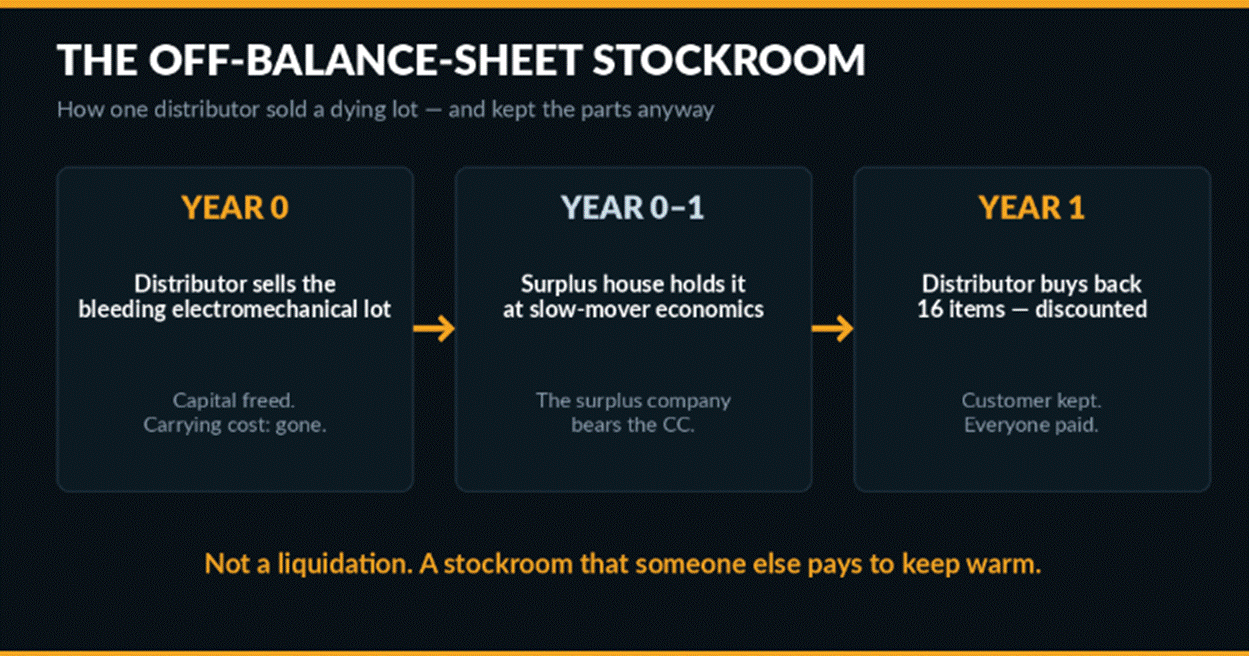
They made the intelligent decision and sold the lot to us. Parts off the shelf, capital back into fast movers that actually help their customers. Smart money knows when to sell.
Here’s what surprises people: within a year, that same distributor bought back 16 items from the lot — at a discount of course — because their customer needed them.
Read that again. They freed the capital, kept the customer, and still had access to the parts. The inventory didn’t fully disappear — it just moved to the shelf that’s built to hold it.
The distributor avoided another year of paying $616,000 to hold the products collecting dust. They only needed 16 parts out of 800+ SKUs Central Surplus purchased.
The parts you think you must hold for your customer — you probably don’t.
Some call that liquidation. In reality it’s an off-balance-sheet stockroom.
That industrial distributor finally recovered money on those parts that year, saved the $616k in carrying costs, put the purchase cash we paid them into technology investments they made and fresh parts, and still made extra-margin on the parts they purchased back from us.
What This Means If You’re Holding Excess
If you’ve got a section of shelving that hasn’t moved in a year, the math is already working against you.
- Price the wait. Pull every SKU with zero turns in 12 months. Add your carrying cost percentage (don’t lie to yourself) for every year it’s been sitting. That number is what “waiting for a buyer” actually costs. (Or, if you prefer, pull SKUs that have not sold in 24 months.)
- Sell while it’s still a part, not scrap. Industrial asset recovery typically returns 28–35% of original cost — 40–50%+ with good timing. A part is worth more the day it’s discontinued than three years later – not technically, but mathematically – if you can’t sell it almost immediately. No matter how you look at it, the longer you sit on a part the more you lose.
- Treat the surplus house as a partner, not an exit. A good surplus house keeps your parts findable. When your customer needs one back, you buy it back — like our distributor partner did, 16 times. The relationship stays yours; the carrying cost doesn’t.
Want a creative idea that lets you keep access to the part? Integrate with us and show us in your ERP system as an off-site warehouse, just like you handle storeroom management services with your customers.
We work with many inventory holders that are simply scared that their customers would buy from us. Makes some sense, but our SKUs are hyper-dynamic. So if you’re really hesitant, we can move the inventory overseas.
And if you’re the plant on the other side of this trade: the secondary market is where discontinued parts actually live now. MRO spares are one of the four major investment-recovery segments for a reason — recovered parts beat new procurement on lead time and cost.
The Clearing House the Chain Can’t Run Without
The US liquidation market more than doubled between 2008 and 2020 to $644 billion. That’s not a junk trade — that’s the industrial supply chain’s clearing house.
Manufacturers get to sunset product lines. Distributors get to run lean line cards. Plants get to keep 20-year-old equipment running without a capital project.
Everyone offloads a cost they couldn’t carry — and someone turns it back into supply.
The operators who treat the surplus channel as infrastructure — selling into it before inventory dies, buying from it before lines go down — turn this cost cycle into margin.
Your dead stock is someone’s line-down fix. Connect those dots before the costs do it for you and stack too high.
Brandon Kelley is an entrepreneur in industrials. His surplus company has purchased more than $500M in inventory, has been to hundreds of DCs, and helps distributors, manufacturers and OEMs recover the highest prices on surplus stock, while remaining the least competitive. If you are looking for a reference, contact sales@central-surplus.com


The 16-item buyback is what makes this real. Most distributors treat surplus as an exit; this shows it working as off-balance-sheet storage they can still draw from, without the carrying cost of dead capital sitting on the shelf.
Yes, most distributors that sell us their surplus come back for a few parts: <1%. While very small, it matters greatly because they can still draw on the parts they need when it counts.