
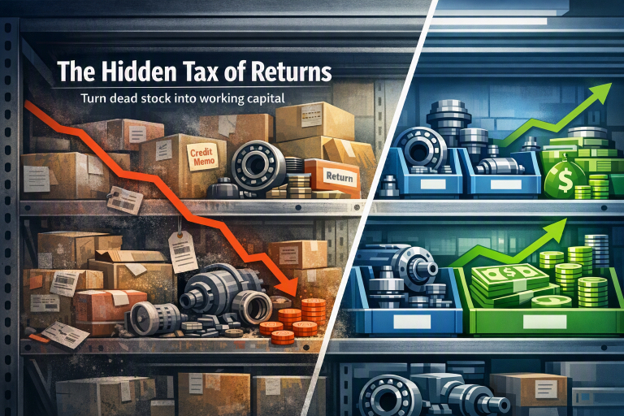
Every distributor has seen it: return shelves overflowing with parts that came back from a customer, parts that never sold, and parts that are technically inventory but functionally furniture.
Returns are the sleeper line item for industrial distributors (and even manufacturers!) They don’t show up in the sales meeting. They show up in the margin — months later, wearing a discreet disguise.
Here’s how it happens, why it happens, and what the smart operators do about it.
Why Returns show up
The industrial supply chain is one of the most fragmented industries globally. Thousands of distributors, selling overlapping lines, sometimes to the same plants.
Thousands of manufacturers, either trying to gain market share, or prevent loss of market share.
That fragmentation means one thing: customers always have another option.
So when a maintenance manager calls and says he over-ordered eighty SKUs for a project that got cancelled, you don’t get to say no. Not if you want the next PO.
We do what it takes to keep our customer base and market share.
So in an effort to keep our customers happy and boost customer service, we take back the inventory they purchased a year ago. Oof.
You can’t just care about the bottom line like a stock broker. Reducing the friction of working with an end user is what winning distributors are doing.
But retention fees burn over time.
Customer Returns
Here’s where it gets expensive — and most of the cost is invisible at the moment you say yes.
- The parts aged on someone else’s shelf. Your customer may have been sitting on that material for many months. Elastomers degrade. Packaging gets shopworn. Date codes matter to the next buyer, and the clock was running the whole time.
- You credit less than you charged — and it still costs you. Issuing 70-80% credit feels like protection. But you’ve taken back product you may not be able to sell at full price, and you’ve tied up cash in the difference.
- Sometimes it’s not even your brand. Customers return whatever’s in the bin. If you’re not an authorized distributor for that line, you now own product you can’t warranty, can’t return upstream, and can’t always represent as new through authorized channels.
- The paperwork is real. Receiving, inspection, re-stocking, re-binning, updating the system. Every return consumes labor that was supposed to be filling orders.
Add it up and a “customer satisfaction gesture” routinely costs more than the credit memo shows.
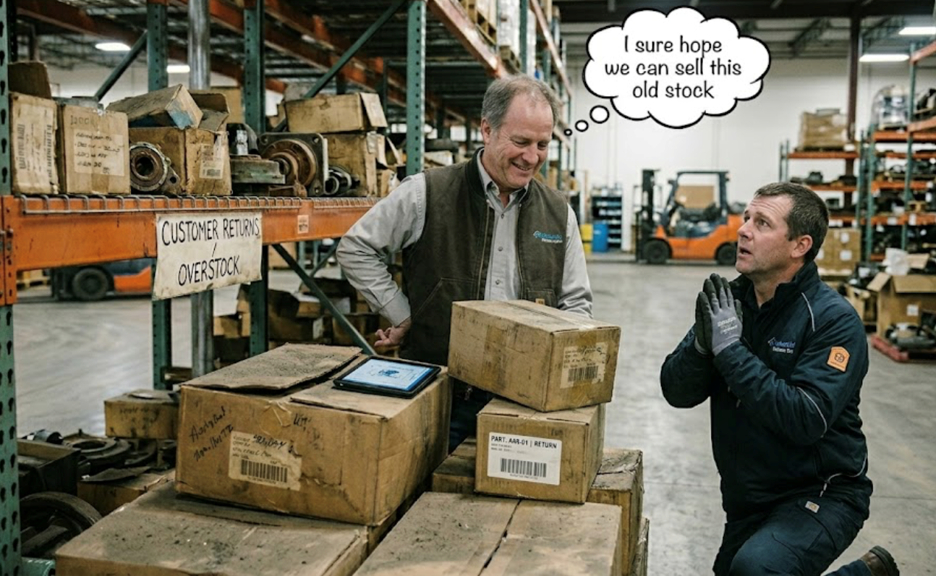
Now Try Sending It Back Upstream to Your Manufacturers!
So the distributor turns around and tries to return their slow-moving stock to the manufacturer. This is where the leverage flips completely.
MFR return programs read like they were written by someone who never wants to see the product again. The standard terms:
- Credit usually, rarely cash. Your money comes back as an obligation to buy more from the same vendor. The capital stays captive. Looping is the norm.
- Age caps. Many programs won’t take product older than 12-24 months. The stuff you most need to move is now the stuff they won’t accept.
- Annual return allowances. Often capped at a small percentage of your prior-year purchases. Bought $500K last year? You might be allowed to return $25K. The other dead stock is your problem.
- 2X swap. Some manufacturers will take back stock — if you commit to purchasing two times the returned value in new product. Read that again. The cure for too much inventory is buying twice as much inventory.
- Restocking fees and return freight. 15-25% off the top, plus you pay to ship it back. Recondition and reboxing fees stack higher than your racking. On heavy industrial product, freight alone can erase the math.
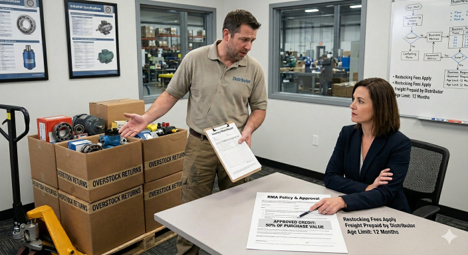
None of this is the manufacturer being villainous. They don’t want aged stock back any more than you want it on your shelf. The terms just make sure you feel that.
And for good reason: no one wants to hold inventory that is not selling, consuming space, and tying up cash at a carrying cost that can reach 28% annualized.
Returning stock back to the MFR can run up 50% of the parts value after many hidden costs are factored in. Ask your finance manager.
A better approach is to handle returns strategically and sometimes send parts downstream.
The Opposite of a Parts Museum –
- Negotiate return terms before the first PO, not after the problem. Return allowances, restock fees, and age limits are all negotiable when the vendor wants your business. They’re carved in granite once you need the favor.
- Put a customer return policy in writing — and actually use it. Time limits, restocking fees, condition requirements. You’ll still make exceptions for good accounts. But an exception to a policy is a relationship decision. No policy is just a blank check.
- Watch special orders like a hawk. Non-stock and special-order items should be non-cancelable, non-returnable by default, with the customer signing off. Most return pain starts with a special order someone treated like a stock item.
- Review min/max settings quarterly. Dead stock is usually a purchasing decision that aged badly. The demand signal changed; the reorder point didn’t.
- Track returns as a metric. Returns by customer, by vendor, by product line. Patterns show up fast — and a customer who returns 15% of what they buy isn’t the customer their revenue number says they are.
What to Do With the Stock You Already Have
Prevention fixes next year. It doesn’t fix the shelf in front of you.
For material that can’t go back upstream — too old, wrong brand, over the allowance — the secondary market exists for exactly this reason. There are buyers actively looking for surplus industrial parts: plants chasing discontinued components, liquidators filling gaps, end users who need the part more than they need the packaging to be pretty.
Try a clearance tab on your ecom. Many times a similar part might work for an end user looking for a deal or some spare stock of their own.
Cash from the secondary market beats credit you’re forced to spend. It beats carrying costs that compound every month. And it definitely beats the dumpster, which is where too much perfectly good material quietly ends up.
The shelf of returned material is better viewed as working capital wearing a disguise rather than a write-off waiting to happen.
The bottom line, literally.
It starts at the source. If you can only order the parts you know will sell and your customers will keep, you are operating lean. Your P&L charts will move be moving up and to the right.
But returns are a structural feature of a fragmented industry — they’re not going away, and pretending otherwise just moves the cost somewhere harder to see.
The spread between distributors who manage returns and those who absorb them is real margin. Terms negotiated upfront. Policies in writing. Dead stock converted to cash instead of credit.
Of course exceptions will be made. Tactfully setting the expectations upfront alleviates any confrontation downstream.
The operators who treat returned material as a process instead of a surprise don’t just protect margin. They free up the cash everyone else has sleeping on a shelf.
That’s not a small edge in a 5.5% net margin business. Do the math.
Because skipping it means a loss on growth.
SEO keyword: industrial distributor returns. Meta description:
Brandon Kelley is an entrepreneur in MRO. His surplus company has purchased more than $500M in inventory from distributors, manufacturers and even contractors / integrators and end-users. He has been to hundreds of DCs, and helps distributors, manufacturers and OEMs recover the highest prices on surplus stock, while remaining the least competitive.


Leave a Reply