

TL:DR Sales dashboards reveal what happened, but they rarely change behavior on their own. Distributors can improve execution by turning ERP data into timely, specific cues that tell each rep which customer to contact, why, and what opportunity to discuss—aligning daily sales actions with strategic growth, retention, and inventory priorities.
Lessons From a Sales Analyst
One of my first career breakthroughs came from pulling data out of an ERP system and building sales reporting dashboards. This was circa 2008, and I was an entry-level analyst at a distributor, where it seemed the chart visuals I created in Excel showing sales and margin trends by account were the first of their kind anyone had ever seen.
Management was thrilled with the new reports, and the sales reps seemed to appreciate having better visibility into what was going on with each of their customers after the reports were updated every month. But despite the early excitement, I could tell the reporting wasn’t affecting the day-to-day activities of our sales reps. The reports were inherently backwards-looking since they were only updated monthly (and after the financial close of each month), but even when they could be using the trends to try and anticipate each customer’s needs, most of the sales reps still spent most of their time reacting to customer requests.
I eventually moved into Marketing and started working directly with our supplier partners. We had a major corporate initiative to expand sales of our “Associated Products” line and chose the strategic vendors we wanted to work with. The vendors sponsored lunch ’n learns at each of our locations. We brought in a stocking package and printed a glossy one-pager our sales team could use to promote the new line. I even added a special section to the sales report highlighting the top accounts buying the new products.
Despite all of this focus, and the dozens of emails we blasted out to sales, we barely moved the needle on Associated Products after the first year. I realized we were giving our team general direction on the sales strategy, but what they really needed was specific guidance they could act on right away.
I eventually had the chance to work with distributors in many different industries and quickly realized the challenges I faced early in my career were not unique. Everyone had high-level sales reports, strategic initiatives, and a sales team that lacked the guidance needed to be more proactive.
It was in these conversations that I came to an important realization: changing the behavior of a sales team required targeted guidance, not general direction. Distributors can print flyers, publish dashboards, send weekly emails, and talk about strategic priorities at sales meetings. But unless a rep can translate that strategy into a focused conversation with a specific customer, very little will change.
Distributors now have much more access to data than I did back in 2008. Tools like Tableau and Power BI make the Excel dashboards I used to create look primitive by comparison. But more information doesn’t easily translate to meaningful action.
A sales rep starting the day doesn’t need another chart showing that sales in the new product line are below their goal — they need to know that Customer X has an obvious gap in a target product category, and exactly which products they can use to start the conversation. They don’t need a pie chart of their quote conversion rate — they need to know that a meaningful quote they sent three days ago has not converted and deserves a follow-up. They don’t need a report showing customers that are down month over month — they need to know exactly which reorders for their recurring business haven’t come in as expected.
That is a fundamentally different way to think about sales enablement.
Instead of asking, “What information should we show our salespeople?” distributors should start asking, “What should this salesperson do next, with which customer, and why?”
Simple Guidance Moves the Needle
That distinction is especially important as AI becomes the answer to nearly every technology conversation. There is no shortage of tools that can summarize information, write emails, answer questions, or generate another layer of analytics. Those capabilities can be useful, but distributors should be careful not to confuse access to AI with better sales execution.

The opportunity is to use technology to connect the strategy of the business with the daily decisions of the sales team.
If the goal is to grow a new product line, identify the customers with the clearest white space and give the rep a credible product suggestion to start the conversation. If the focus is on customer retention, flag unusual purchasing gaps before the customer quietly shifts that business elsewhere. If there’s an initiative to move slow or distressed inventory, identify the customers most likely to have a need for it and give the rep a reason to call them.
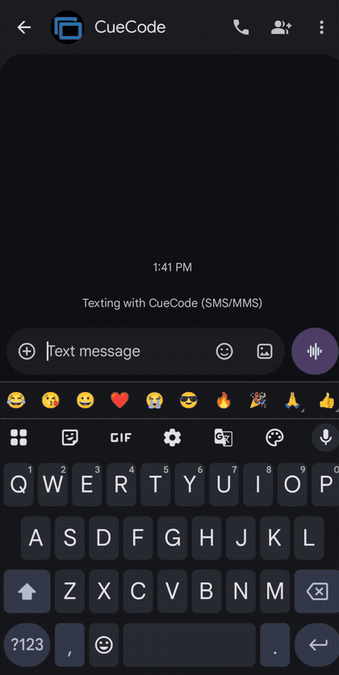
I launched CueCode to solve this exact challenge. Using any distributor’s ERP data, CueCode uncovers hidden revenue opportunities in every account, and gives marketing and sales ops teams a system to align the actions of the sales teams with the strategies of today. The platform generates simple and timely “cues” for each sales rep, so that no sales rep needs to become a data analyst. That’s not what you hired them for anyway! You can learn more about CueCode at cuecode.io.
I still love a good dashboard. I built enough of them over the years to appreciate what they can teach us about a business. But if I could go back to 2008, I would spend less time asking how to make the report more impressive and more time asking a much simpler question:
What does your salesperson need to know right now to have a more productive customer conversation?

Brian Hirt is the founder of CueCode, a software solution built to provide day-to-day selling guidance to wholesale distributors. Before starting CueCode, Brian spent 5 years in wire and cable distribution followed by over a decade consulting and building software for distributors and manufacturers in a variety of industries. He now works to onboard new distributors getting started with CueCode and celebrating with his existing customers growing sales every day!


Leave a Reply