

What can an inventory holder do with excess inventory, why does it happen?
In MRO & Industrial, inventory is a double-edged sword; it’s the lifeblood and the weight. With gross margins around 30%, it is pretty attractive, but all distributors have experienced a “just-in-case” order for a critical part turning into five years of dust-collecting deadstock. Looking into 2026, the MRO distribution market shows ‘gain’ signs, yet many distributors, manufacturers and OEMs find their capital trapped in rows of surplus, excess, inactive, SLOB inventory or dead stock.
Whatever you want to call it…the opportunity costs are stacking.
Why the Pile-Up Occurs
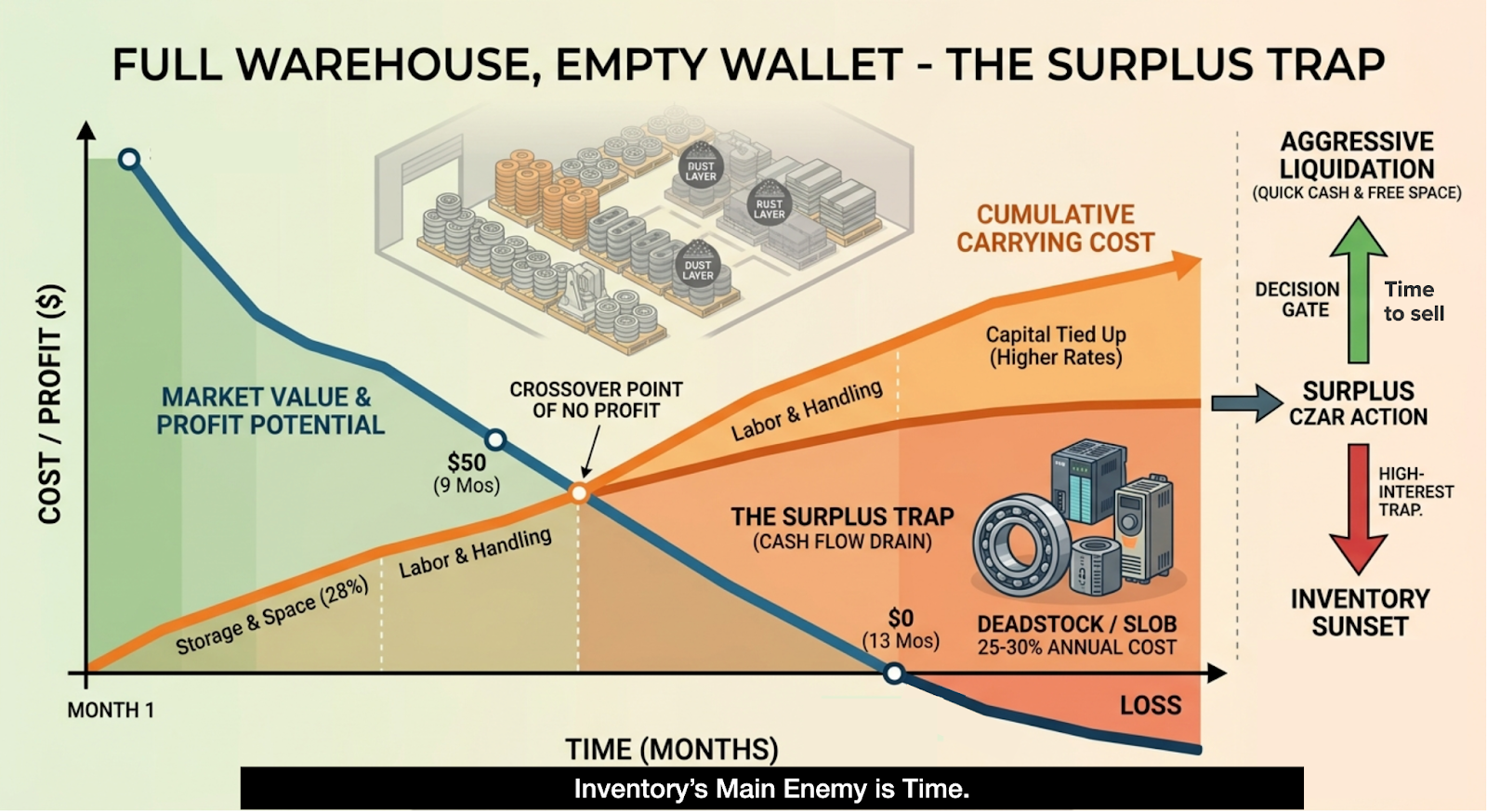
- The Volume Discount Mirage: Purchasing teams often chase unit-price breaks by buying in bulk. However, when you factor in the 25-30% annual carrying cost of industrial goods, a 10% discount disappears if that stock sits for more than nine months. This doesn’t happen to consumers purchasing mega packs of paper towels at Costco.
- Defensive Stockpiling ‘PTSD’: Post-pandemic Just-in-Case mentalities have led to mountainous safety/buffer stocks. Without AI-driven demand sensing, these buffers quickly turn into deadstock as customer needs shift.
- The Substitution Black Hole: When a functional equivalent is sold because the primary SKU is out, ERPs often fail to sync. This can be due to siloed systems or fuzzy data, resulting in the system auto-ordering parts that are no longer being requested by the field.
- Technological Obsolescence: As end-users pivot to Industry 4.0 and IIoT-enabled machinery, the spare parts for legacy equipment become instant museum pieces. If you aren’t synced with your customers’ CAPEX cycles, you’re buying for a ghost fleet.
- Reverse Logistics Limbo: Canceled project kits and unmanaged returns often sit in a warehouse “grey area.” Without a formalized recovery process, this high-value inventory remains invisible to sales teams and unavailable for resale.
- Customer Returns: In a marketplace full of competition, we do what it takes to keep our customers. When they return parts for us to sit on, it’s usually the slow-moving stuff.
If your warehouse is looking more like a parts museum than a fulfillment center, it’s time to pivot.
Become a Surplus Hero
- Appoint a Surplus Czar: Centralize the authority to move old stock. This role sits between Sales and Purchasing to ensure unproductive inventory is converted to cash rather than hidden under a dust layer.
- Kill the Min/Max Manual Entry: Implement dynamic reorder points that adjust based on real-time lead-time volatility and actual consumption, not historical guesses. What’s in Bob’s head needs to be built into a system. Always think systems.
- Aggressive Liquidation: Don’t wait for a miracle customer. Without cannibalizing your customer base, cross-sell and bundle slow-movers with bestsellers, use them as loyalty rewards, or list them on niche B2B marketplaces. Even a loss-leader sale beats 28% annual carrying costs and frees up valuable space.
- ITR > Margins: Yes, we have to keep A & B parts in stock and make them available for our customers. But you can shift KPI structures so that procurement is rewarded for liquidity and inventory velocity rather than just lowering the PO price. Think C & Ds.
- The 90-Day Sunset Rule: Establish an easy-to-follow standard operating procedure to identify and liquidate items that haven’t moved in a quarter- the first loss is the cheapest loss. This aligns with turning your inventory 4 times per year, a great start. Aim for 7-8.
- Keep your customers happy: Throw in spares or cross-sells for your customers, for Free. This gets the parts off your balance sheet and lets your customers know “hey, you might need this part again or this complementary part, we appreciate you as a customer and we thank you for your loyalty.”
We would need many more articles to cover all the reasons for inventory build up and ways to solve the issue. But I personally think I have found the main culprit: the analytical mind.
I have been to hundreds of warehouses filled with ‘new-old-stock’ and years worth of parts.
For me I see tied up capital, lost opportunities and a bloated model.
But the inventory holder may see it differently.
Inventory Management Needs a Psychological Mindset Shift
It takes a psychological mindset shift to reduce the amount of inventory being held.
“We can’t sell that part for $50, it’s worth $100!”… yea maybe, but no one has purchased it. It’s been in the warehouse for 13 months – now unprofitable – costing you money every day it sits on the shelf.
To overcome this psychological block, look at how lean companies handle this – they figure out how to sell it, scrap it, or donate it. They don’t tie up capital for long.
Inaccurate Data Reduces Inventory Accuracy
The second major issue I see is inaccurate data. Inventory accuracy is often treated as a warehouse problem, but it’s actually a communication problem between the physical floor and the digital system.
To fix this I recommend implementing a full time IT pro to help build the systems, implement the technology and keep all users using.
We usually hear how expensive it is and “where do we even start?”. And I get it, this industry is not loaded with Industrial IT personnel begging to jump into MRO.
Pro Tip: Find someone familiar with tech stacks; ERM, CRM, WMS, databases, systems, scripts, etc… and during on-boarding, train them on the industry and how your business operates.
There are many tools and technologies that are becoming mainstream and inexpensive addressing inventory issues.
Inventory masquerades itself as an asset. In a high-interest-rate environment, the most successful distributors aren’t those with the biggest warehouses, but those with the fastest capital turnover.
Liquidity is your best competitive advantage. Safety nets cause surplus inventory. Treat your warehouse like a high-speed engine and watch your cash flow, flow.
Brandon Kelley is an entrepreneur in MRO. His surplus company, Central Surplus, has purchased more than $500M in inventory, has been to hundreds of DCs, and helps distributors, manufacturers and OEMs recover the highest prices on surplus stock, while remaining the least competitive.


Leave a Reply